Mirror acrylics have become a go-to for modern interiors, retail displays, and commercial fabrication. Its reflective appeal of traditional mirrors comes with the lightweight durability of acrylic.
In total, these sheets offer a versatile and cost-effective solution for scalable design and production. This in-depth guide helps evaluate mirror acrylic products from technical and commercial perspectives.
What are Mirror Acrylic Sheets?
Mirror acrylic sheets are made from PMMA with a reflective metallic coating applied to one side. The coating, primarily aluminum-based, is vacuum metalized to create a mirror-like surface.
Key Features at a Glance
- Up to 50% lighter than glass mirrors.
- Shatter-resistant and safer for public environments.
- Easy to cut, drill, and fabricate.
- Available in multiple colors and finishes.
- Suitable for flat and curved installations.
Unlike glass, mirror acrylic offers design flexibility and reduced installation complexity. That’s exactly why it remains ideal for commercial-scale projects.
How is a Mirror Acrylic Sheet Made?
Do you really need to know the manufacturing process behind mirror acrylic sheet? Yes, it defines the difference between a product that performs over a decade and one that deteriorates within months.
Mirror acrylic sheet begins with a PMMA (polymethyl methacrylate) substrate. The sheet is then passed through a vacuum metalizing chamber. There, aluminum or silver metal is vapor-deposited onto the back surface in an extremely thin but uniform layer.
The metallic layer becomes the reflective element, bouncing light back through the PMMA substrate to create the mirror effect. A protective lacquer or paint is then applied over the metallic coating to seal it against moisture, adhesive contamination, and mechanical damage.
a. Cast vs Extruded Substrate
The PMMA base material is produced by one of two methods. Your choice between the two has direct consequences for optical quality. Cast PMMA is produced by polymerizing liquid monomer between two flat glass plates.
It creates a sheet with a highly consistent molecular structure and minimal thickness variation. Extruded PMMA is produced by pushing material through a shaped die. It introduces greater thickness variation across the panel width.
b. Virgin vs Recycled PMMA
The purity of the base material determines three properties: UV stability, batch-to-batch consistency, and the clarity of the substrate. Virgin PMMA maintains these properties reliably.
Blended or recycled content introduces variability that is acceptable in some commodity applications. But it’s quite problematic, where color consistency across panels is a visible quality benchmark.
c. First-Surface vs Second-Surface
Standard commercial mirror acrylic is a second-surface mirror: the reflective coating is on the back of the PMMA substrate, and light passes through the clear acrylic before reflecting. It’s the correct construction for virtually all commercial applications.
First-surface mirrors, where the coating is on the front, are used in specialist optical instruments. The distinction matters only when evaluating supplier specifications: second-surface is the standard; first-surface is a specialist product at significantly higher cost.
Mirror Acrylic Sheet Types: Color and Finish Guide
Silver mirror acrylic is where most buyers start, but it is far from where the range ends. Mirror acrylic is available across an extensive spectrum of colors and metallic tones.
01. Silver Mirror Acrylic
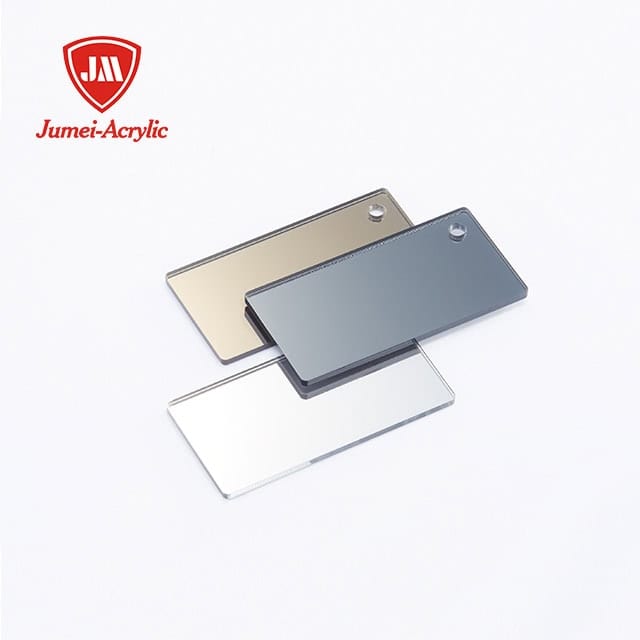
The benchmark product in the range. Silver mirror acrylic delivers the closest visual approximation to traditional glass mirror — a neutral, cool-toned, high-reflectivity surface that reads as “mirror”.
Quality silver mirror acrylic from a virgin PMMA cast substrate achieves reflectivity in the 85–90% range. For comparison, flat glass mirrors typically achieve 92–95%; not much noticeable difference.
02. Gold Mirror Acrylic
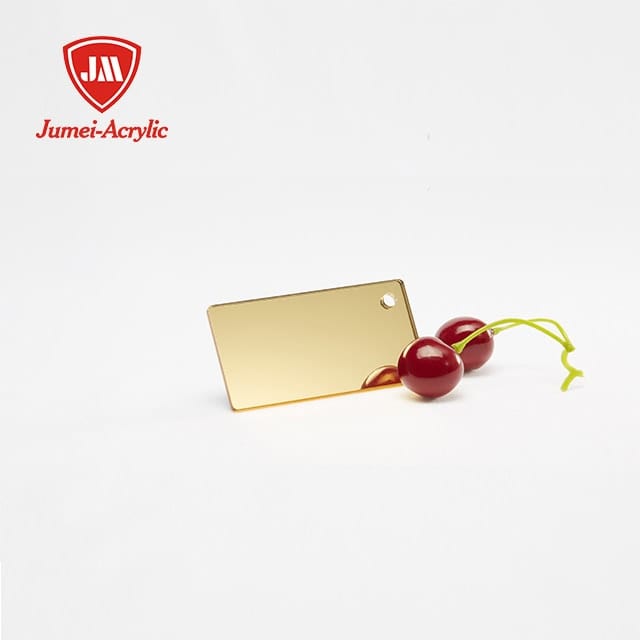
Gold mirror acrylic uses a warm yellow-gold metallic coating that creates a distinctly luxurious aesthetic character. The reflective quality is strong, but unlike silver, it adds a warm color cast to reflected images rather than reproducing them neutrally.
Primary applications span hospitality interiors, luxury retail environments, high-end event backdrops, and premium signage. Gold mirror acrylic is a dominant specification choice in Middle Eastern, Southeast Asian, and South Asian commercial interior markets.
03. Rose Gold Mirror Acrylic
Rose gold’s trajectory from jewelry trend to mainstream interior finish is well-established across many commercial design sectors. And rose gold mirror acrylic has followed the trajectory into commercial specification.
The finish combines a warm pink tone with gold metallic undertones, producing a result that reads as feminine, contemporary, and premium without the heaviness of full gold. The aesthetic is particularly responsive to the lighting environment.
04. Bronze and Antique Bronze Mirror Acrylic
Bronze mirror acrylic occupies an aesthetic space between gold and black; it reads as sophisticated and heritage-inflected in a way that neither gold nor silver achieves. Where gold says luxury and silver says contemporary, bronze says character.
It’s the material of choice for upscale boutique hospitality environments — members’ clubs, fine dining restaurants, boutique hotels — where the design language intentionally references craft, history, and depth rather than modernity.
05. Black Mirror Acrylic
Black mirror acrylic is a semi-reflective surface that absorbs significantly more light, creating a depth effect. The objects appear on the surface as if seen through darkened glass rather than reflected in a conventional mirror.
Primary applications include high-end retail environments where a non-distracting reflective backdrop is needed behind displayed merchandise, architectural interior features in monochromatic design schemes, and luxury furniture elements.
06. Colored Mirror Acrylic
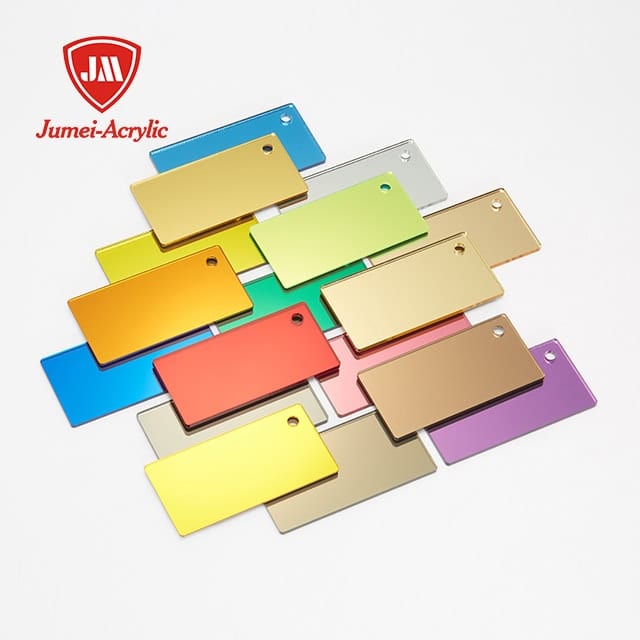
Beyond the metallic tones, mirror acrylic is available in a range of vivid saturated colors — blue, red, green, purple, orange, yellow, and pink. These produce tinted reflections that add color to the reflected image rather than reproducing it neutrally.
Colored mirror acrylic is heavily used in retail point-of-sale displays, event installations, themed interior environments, children’s spaces, and any application where reflective color is the design intent.
Reflectivity, Optical Quality, Performance
- Reflectivity Ratings: Mirror acrylic typically offers 70–90% reflectivity, slightly lower than glass (90–95%). However, for most decorative and commercial uses, the difference is negligible.
- Image Clarity vs Thickness: Thinner sheets mean better clarity. Meanwhile, thicker sheets provide slightly more distortion if not mounted properly.
- Surface Flatness Matters: Unlike rigid glass, acrylic can flex. Install on perfectly flat surfaces and avoid uneven substrates. Don’t forget to use proper mounting techniques.
Color Selection Reference Table
| Finish | Tone | Primary Applications | Reflectivity | Typical Thickness |
|---|---|---|---|---|
| Silver | Cool neutral | Gyms, retail, public spaces, functional mirrors | High (8590%) | 1.56mm |
| Gold | Warm yellow-gold | Hospitality, luxury retail, events, signage | High (8088%) | 25mm |
| Rose Gold | Warm pink-gold | Beauty retail, boutiques, weddings, events | High (7885%) | 24mm |
| Bronze | Dark warm brown | Upscale hospitality, architectural features | Medium-high | 25mm |
| Black | Dark semi-reflective | Contemporary interiors, luxury furniture | Low-medium | 25mm |
| Colored variants | Saturated tints | POS displays, events, themed design | Medium | 23mm |
Mirror Acrylic vs Glass Mirror vs Chrome Film
Three materials compete for reflective surface applications in commercial design. Understanding precisely what each does and what each cannot do is the fastest route to the right specification.
Mirror Acrylic vs Glass Mirror
Reflectivity: Glass mirrors achieve 92–95%+ optical reflectivity with zero image distortion when flat and properly manufactured. Quality cast-substrate mirror acrylic achieves 85–90%, entirely adequate for all decorative and most functional applications.
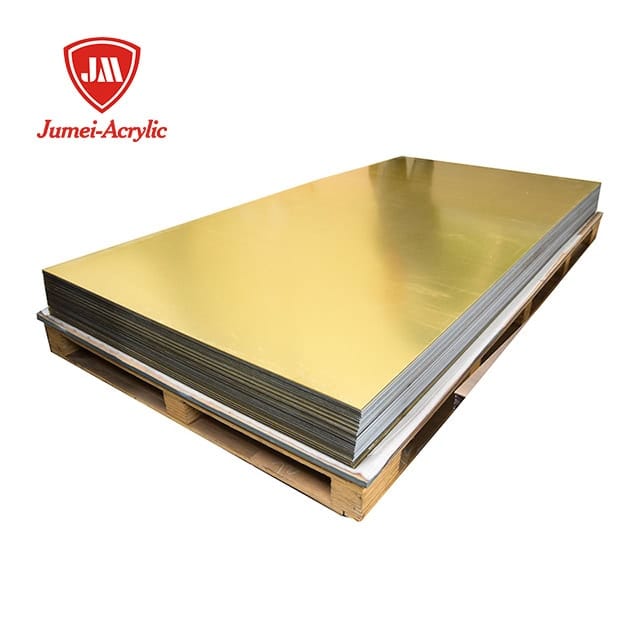
Weight: Mirror acrylic is approximately half the weight of glass at equivalent thickness. A standard 1220×2440mm sheet at 3mm thickness in glass weighs approximately 15–16kg. The same panel in mirror acrylic weighs 7–8kg.
Impact Resistance: Mirror acrylic is approximately 17x more impact-resistant than glass of equivalent thickness. On impact, mirror acrylic may crack or scratch — it does not shatter into sharp shards.
Fabrication: Mirror acrylic can be cut with standard workshop tooling available to any plastics fabricator — table saws with fine-tooth blades, CNC routers, and score-and-snap for straight cuts. Glass mirror requires specialist cutting equipment, cannot be drilled without significant breakage risk.
Curved Surfaces: Mirror acrylic can be cold-formed around curved substrates within the material’s flex tolerance. Glass mirrors cannot be curved.
Long-Term Performance: Both materials have long service lives when properly installed and maintained. Glass mirrors can develop “black edge” deterioration — a degradation of the silver backing along the mirror perimeter — when exposed to sustained humidity.
Mirror Acrylic vs Chrome/Mirror Vinyl Film
Chrome or mirror vinyl film is an adhesive-backed material that can be applied to almost any substrate. It creates a superficially similar reflective surface at very low material cost.
Film installations are subject to edge lifting and bubbling as the adhesive bond weakens over time — particularly in temperature-cycling or humidity-variable environments.
The thin film transmits every surface irregularity of the underlying substrate directly into the reflection, producing visible distortion that worsens as the substrate ages.
In commercial environments with regular cleaning, chrome film typically requires replacement within two to five years. Mirror acrylic panel installations routinely perform for ten years or more.
Chrome film is legitimate in event installations where it will be used once and discarded, in tight-radius curves where acrylic can’t flex, and in budget-constrained short-term decorative uses.
Summary Table: Glass vs Mirror vs Chrome
| Factor | Glass Mirror | Mirror Acrylic | Chrome Film |
|---|---|---|---|
| Reflectivity | Highest (9295%) | High (8090%) | Medium (variable) |
| Weight | Heavy (~15kg/sheet) | Half of a glass (~78kg) | Negligible |
| Impact resistance | Low shatters | Very high no sharp shards | N/A (applied film) |
| Curved surfaces | No | Yes (cold-bend) | Yes (flexible) |
| Longevity | 1525 years | 1015+ years | 25 years |
| Fabrication | Specialist tools required | Standard workshop tools | Knife and squeegee |
| Color range | Limited | Extensive | Limited |
| Bulk shipping cost | High (weight + fragility) | Moderate | Low |
| Best for | Precision optical mirrors | Commercial design applications | Short-term/temporary use |
Where Does Mirror Acrylic Sheet Perform the Best?
a. Retail Display Walls and Fixtures
Mirror acrylic is one of the most widely specified materials in global commercial retail fit-out. Its reflective surface serves two simultaneous commercial functions: it makes retail spaces appear significantly larger, and it acts as a passive product presentation tool.
b. Hospitality Interiors: Hotels, Restaurants, and Bars
The hospitality sector was among the first commercial categories to adopt mirror acrylic at scale, driven by the convergence of safety requirements, installation practicality, and the material’s extraordinary capacity to amplify light in spaces that are often architecturally constrained.
c. Event Backdrops and Installations
Events are the application context where mirror acrylic’s physical advantages over glass are most practically consequential: it travels, it installs without a specialist crew, and it survives the repeated handling, transport, and reinstallation cycles of a touring event build.
d. Signage: Reflective Letters, Logos, and Brand Identity
Mirror acrylic’s combination of reflective visual impact and full machinability makes it the material of choice for premium commercial signage applications where standard colored acrylic, printed substrates, or backlit panels are not sufficiently distinctive.
Installation Guide: Mirror Acrylic on Flat, Curved, and Overhead Surfaces
Mirror acrylic installations that fail — warped panels, distorted reflections, delaminated coatings — are almost entirely the result of installation errors rather than material defects.
01. Non-Negotiable Foundation: Flat, Rigid Backing
Unlike glass, mirror acrylic is flexible. Any irregularity in the mounting surface — a bow in the wall, a lump in the plaster, an uneven substrate board — transmits through the sheet and appears as image distortion in the reflection.
02. Adhesive Selection: The Most Commonly Misunderstood Step
Standard construction adhesives, contact cements, and solvent-based adhesives will attack and destroy the protective lacquer backing on mirror acrylic, causing the reflective aluminum coating to delaminate from the substrate.
03. Mechanical Fixing: Screw and Clip Methods
For applications where adhesive-only mounting is not appropriate — wet or humid environments, high-vibration locations, frequently dismantled display systems, or installations where future panel replacement must be simple.
04. Installation on Curved Surfaces
Cold-bending mirror acrylic around curved substrates is one of the material’s most commercially useful properties and one that clearly distinguishes it from glass. The technique requires understanding the material’s flex limits for each thickness.
05. Ceiling and Overhead Installations
Ceiling installation is the highest-risk use that requires specific structural caution. Mirror acrylic should never be installed overhead using adhesive. The long-term risk of adhesive creep, combined with the consequences of panel failure overhead, makes mechanical fixing mandatory.
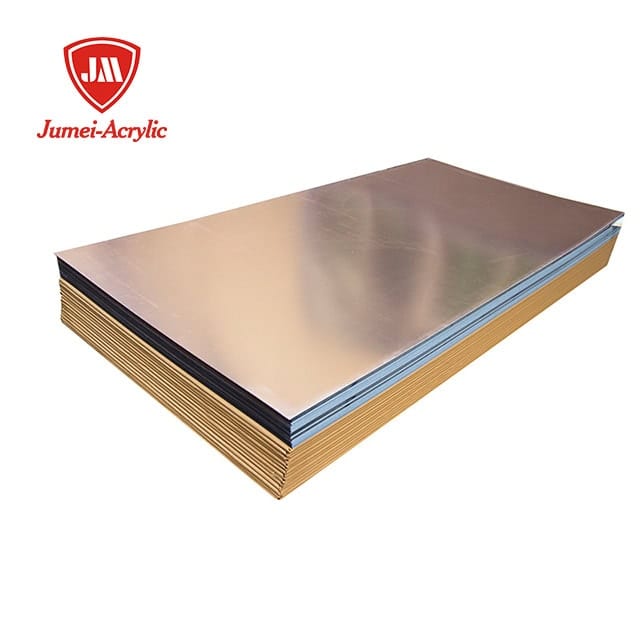
Buying Mirror Acrylic in Bulk: Guide for Wholesale Importers and Fabricators
The economics, flexibility, and specification options available to a buyer sourcing direct from a mirror acrylic manufacturer are fundamentally different from those available through local distribution.
What to Specify When Ordering?
Color and Finish: Silver, gold, rose gold, bronze, black, or a specific colored variant. For custom colors, provide a target RAL or Pantone reference and confirm whether you need an exact or a close match.
Substrate Type: Cast or extruded PMMA base. Specify cast for commercial and fabrication applications requiring optical consistency and minimal distortion.
Thickness: In millimeters. Provide your application context so the supplier can confirm suitability — the same color at different thicknesses has significantly different handling and installation properties.
Sheet Size: Standard sizes are typically 1220×2440mm (4×8ft) and 1220×1830mm (4×6ft). Custom sizes are available with minimum order quantities.
Reflective Coating: Aluminum coating (standard, cost-effective, suitable for all commercial applications) or silver coating (higher reflectivity and slightly improved color accuracy, premium specification).
Tolerance Specs: Standard thickness tolerance is ±10%. For precision fabrication applications — particularly where cut pieces will be assembled edge-to-edge — specify ±0.2mm thickness tolerance.
Certifications: Specify which are required for your import market. CE and ROHS are mandatory; SGS and REACH are increasingly required by procurement teams in North America and the GCC.
Protective Packaging: Confirm that the mirror face will be masked with protective film for transit, that sheets will be interleaved with paper or foam between panels.
Choosing the Right Manufacturer
Selecting a supplier impacts product quality, delivery timelines, and long-term business success. You’d better look for –
- Strong production capacity
- Export experience
- Customization capabilities
- Consistent quality control
At Jumei Acrylic, you’ll get advanced mirror-coating technology in a wide range of colors and finishes. A reliable bulk supply comes with custom OEM/ODM solutions.
Conclusion
Mirror acrylic sheets offer an unmatched combination of aesthetics, flexibility, safety, and cost-efficiency, making them a top choice for modern commercial applications. This material enables businesses to create visually stunning environments without the limitations of traditional glass mirrors.
Top-Tier Mirror Acrylic Sheets for Your Project at JUMEI
Jumei Acrylic is certified to ISO 9001:2015, CE, SGS, REACH, and ROHS. You can have mirror acrylics in silver and gold within a full range. Contact us to request free samples to check whether we’re the ultimate option for your specs.