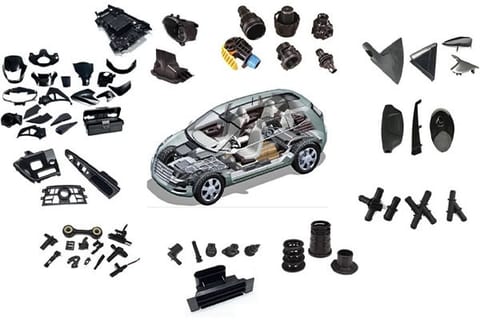
The automotive industry is undergoing a profound transformation. Materials that once played minor roles have become central to innovation, and among these, acrylic has emerged as a powerful solution.
Acrylic is redefining how vehicles are designed, customized, and manufactured. This comprehensive guide explores how acrylic is used in automotive design, including its benefits and compliance specs.
Why Does Acrylic (PMMA) Work in Automotive Design?
Acrylic, or polymethyl methacrylate (PMMA), is a transparent thermoplastic. The material is well-known for its optical clarity, lightweight structure, and weather resistance.
Key Properties of Acrylic Relevant to Automotive Applications
- Lightweight: Approximately 50% lighter than glass, helping improve fuel efficiency and EV range.
- High Optical Clarity: Up to 92% (94% at Jumei) light transmission—ideal for lighting and displays.
- UV Resistance: Maintains maximum clarity and color over time, without yellowing.
- Impact Resistance: More durable than glass for safe and steady use (but less than polycarbonate).
- Ease of Fabrication: Acrylic parts can be cut, drilled, polished, and thermoformed.
Limitations to Consider
- Lower impact resistance compared to polycarbonate.
- More prone to scratching than glass.
- Limited heat resistance in extreme environments.
Property Compared: PMMA vs Key Alternatives in Automotive
| Property | PMMA | Glass | Polycarbonate (PC) |
|---|---|---|---|
| Light transmittance | 92% | 8790% | 8588% (uncoated) |
| Weight vs. glass | 50% lighter | Baseline | 45% lighter |
| Impact resistance | 2× glass | Baseline | 1030× glass |
| UV stability (uncoated) | Excellent | Excellent | Poor requires coating |
| Surface hardness | High | Very high | Lower scratches easily |
| Thermoformable | Yes | No | Yes |
| Mold-in color | Yes | No | Yes |
| Relative cost | Moderate | Lowmoderate | Higher |
Exterior Lighting: PMMA’s Most Established Automotive Role
The outer lens cover of an automotive light is one of the most technically demanding single parts. It must transmit light with minimal distortion, withstand temperature extremes, resist UV degradation, withstand stone-chip impact, and maintain optical clarity.
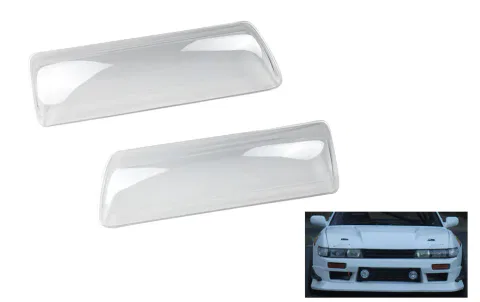
a. Headlight Covers and Lens Assemblies
PMMA and polycarbonate are the two primary competing materials for headlight outer lens covers, and the choice between them is a genuine engineering trade-off rather than a default decision.
PMMA’s advantages for headlight lens specification are substantial: superior inherent UV stability without the need for an outer protective coating, higher optical clarity (92% vs 85–88% for uncoated PC), better surface hardness and scratch resistance, and superior long-term color stability.
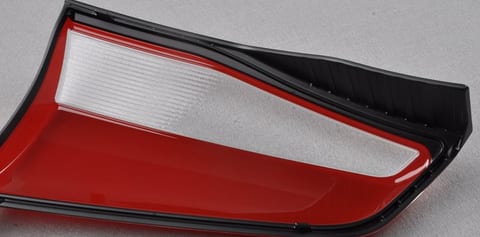
b. Taillight Lenses and Rear Lighting
Taillight assemblies are the application category where colored PMMA most comprehensively outperforms competing materials.
The taillight’s heat load and stone-chip exposure are considerably lower than those of a headlight. It removes the impact and thermal trade-offs that complicate front lighting specification. It further allows PMMA’s superior optical and color properties to be fully utilized.
c. Fog Lights, DRLs, and PMMA as a Light Guide
Daytime running lights (DRLs) represent one of PMMA’s fastest-growing automotive applications, driven by regulatory mandates in most global markets.
The continuous, edge-to-edge light strips that define the front face of modern vehicles — from the thin horizontal lines of a luxury sedan to the complex geometric patterns of an SUV — are made possible by PMMA’s function as a light guide.
Instrument Clusters, Dashboards, and Interior Display Panels
The transition from analog gauges to fully digital instrument clusters and expansive screen-integrated dashboard architectures has transformed the material requirements for vehicle interiors.
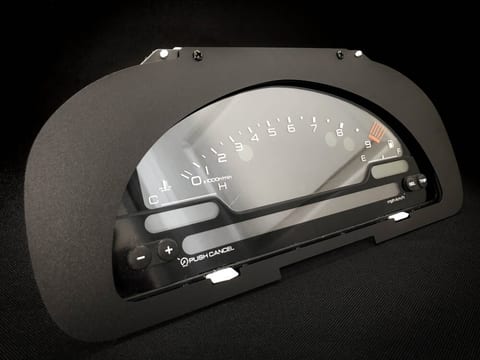
a. Instrument Cluster Covers and Display Protective Panels
The cover lens over a digital instrument cluster or large-format infotainment screen is an optically demanding component.
It must transmit screen content with maximum clarity and minimum surface reflection. The same goes for resisting the fingerprint marking and cleaning abrasion. Maintaining dimensional stability across temperature extremes that can swing from -40°C to +85°C in parked states is also crucial.
b. Dashboard Trim Panels and Center Console Inserts
Decorative trim panels in vehicle dashboards and center consoles are among the most commercially active PMMA applications in both OEM production and aftermarket customization.
High-gloss PMMA in piano black is the dominant finish for dashboard trim strips, center console surrounds, gear selector frames, and control panel bezels across a wide range of production vehicles from mainstream to luxury.
c. Head-Up Display Optical Components
Head-up displays project driving information onto the windscreen or a dedicated combiner element for driver viewing without eyes-off-road time.
The optical requirements for HUD components are among the most demanding in the automotive interior: zero measurable image distortion, precise control of refractive index uniformity across the optic, and long-term dimensional stability under sustained thermal cycling.
Ambient Lighting Systems: PMMA as a Light Architecture Material
The automotive interior ambient lighting market was valued at approximately $2 billion in 2025 and is forecast to grow at 9–11% annually through 2034, reaching over $5 billion.
a. PMMA Light Guides in OEM Ambient Lighting
In OEM ambient lighting systems, PMMA light guides are the structural architecture of the light output.
A thin PMMA profile — typically 2–6mm in cross-section, running along the length of a door panel, dashboard edge, footwell perimeter, or center console — receives LED input at one end and distributes light along its full length through engineered internal scattering elements.
b. Diffuser Panels and Backlit Interior Surfaces
Where light guide strips deliver light to a zone, diffuser panels distribute it across a surface.
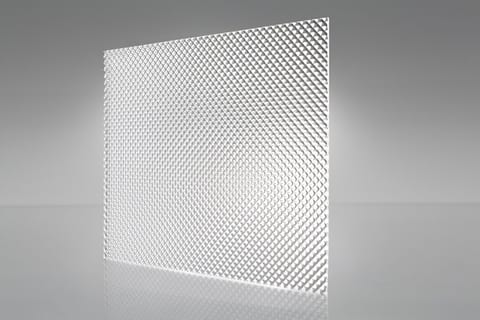
Frosted or opal PMMA diffuser panels are specified for overhead lighting arrays, backlit dashboard surface panels, and illuminated door card inserts where the design intent is a soft, even area of light rather than a linear strip.
c. The Aftermarket Ambient Lighting Opportunity
The aftermarket ambient lighting segment is growing faster than the OEM segment on a percentage basis.
It’s driven by the very large installed base of production vehicles without factory ambient lighting and a consumer market with strong demonstrated interest in interior personalization. Car owners retrofitting ambient lighting to production vehicles are a commercially significant and rapidly expanding category.
Aftermarket Accessories and Custom Vehicle Components
The aftermarket vehicle customization market is a global, multi-billion-dollar industry, and PMMA sheet is among its most versatile fabrication materials.
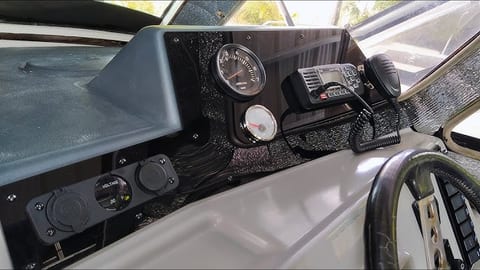
a. Custom Dashboard and Interior Trim Overlays
Custom dashboard trim overlays — panels cut from PMMA sheet in mirror, glitter, colored, or carbon-look finishes, matched to specific vehicle model dashboard profiles — are among the most commercially active aftermarket PMMA applications for small- and medium-sized fabricators globally.
Template sets for popular vehicle models (Toyota RAV4, Honda CR-V, Ford F-Series, Tesla Model 3 and Model Y, and similarly high-volume platforms) can be CNC-routed or laser-cut on demand from standard PMMA sheet in multiple finishes.
b. Wind Deflectors, Vent Visors, and Exterior Formed Components
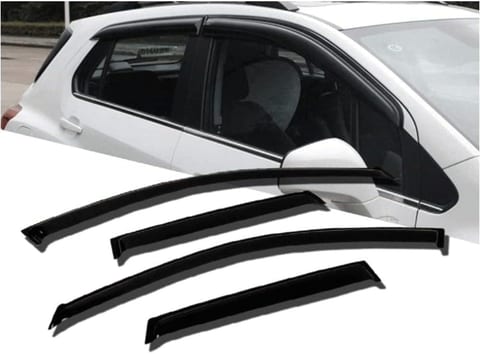
Wind deflectors — the curved acrylic profiles fitted above vehicle door windows to allow partial window opening in rain — are among the highest-volume aftermarket PMMA sheet applications globally.
The component seems simple, but its specification requirements are genuinely demanding: outdoor UV exposure throughout the full vehicle service life, repeated thermal cycling (summer heat and winter cold), and mechanical stress from daily window operation against the deflector’s lower edge.
c. Fleet Vehicle Partitions and Interior Panels
Fleet vehicles include police cars and emergency vehicles, taxis and ride-share cars, ambulances, secure transport vehicles, and commercial vans.
They frequently require interior partition panels separating the driver’s cab from the rear passenger or cargo compartment. A clear PMMA sheet is the dominant material specification for these partitions across most fleet categories.
d. Protective Covers and Competition Vehicle Components
Acrylic protective covers for specific exterior components — headlight guards on off-road and competition vehicles, stone chip protection panels on bonnets and front spoilers, fuel filler surround protectors.
For off-road and competition vehicle applications, impact-modified PMMA grades that extend the material’s baseline impact resistance are the appropriate specification.
UV-Stable Colors in Automotive PMMA: What Specifiers Need to Know
In automotive applications, UV stability is not a feature—it is a baseline requirement. A headlight lens that yellows within three years, a taillight that fades from vibrant red to washed-out orange, a dashboard panel that discolors in sunlight visible from outside the vehicle.
a. How UV Degradation Works in PMMA?
UV degradation in PMMA occurs through photooxidation: UV radiation in the 300–400nm wavelength range breaks the polymer chains in the PMMA matrix, producing yellowing at first, followed by surface hazing and eventually chalking in severely degraded material.
In standard PMMA formulated without UV stabilizers — or in recycled or blended-content material where stabilizer distribution is inconsistent — this process begins with solar-spectrum UV exposure and accelerates in high-UV climates.
b. UV Stabilizer Systems in Automotive-Grade PMMA
Automotive-grade PMMA incorporates UV stabilizer packages — typically combinations of ultraviolet absorbers (UVAs) and hindered amine light stabilizers (HALS) — that absorb incoming UV radiation and convert it into heat.
The effectiveness of the stabilizer package is a function of both the stabilizer loading level and the uniformity of its distribution through the PMMA matrix — both of which are more reliably controlled in virgin-material production.
c. UV-Stable Color Acrylic for Exterior Applications
Colored PMMA for automotive exterior use — taillight red, turn signal amber, reversing light white, smoked clear — requires both UV-stable pigments and a UV-stable base resin to deliver long-term color consistency.
Pigment selection matters significantly. Inorganic pigments (iron oxides, certain metal oxides) are inherently more UV-stable than organic alternatives but require confirmation of REACH and RoHS compliance for European market applications.
Key UV Testing Standards Reference
| Standard | Application | Test Method | Key Metric |
|---|---|---|---|
| SAE J2527 | Exterior automotive | Xenon arc, accelerated | Delta YI after 2,500 hours |
| SAE J1885 | Interior automotive | Xenon arc, accelerated | Color change, gloss retention |
| ISO 4892-3 | Exterior (international) | Xenon arc (equiv. J2527) | Delta YI, haze increase |
| ASTM D4674 | Acrylic-specific UV | UV fluorescent lamps | Various optical properties |
Automotive Safety Standards and Compliance
PMMA components in automotive applications are governed by a layered compliance framework that varies by component type, application position (interior vs exterior), and target sales market.
FMVSS 108: Automotive Lighting (United States)
Federal Motor Vehicle Safety Standard 108, administered by the National Highway Traffic Safety Administration (NHTSA), governs all automotive lighting components sold in the US market.
PMMA lens materials in lighting assemblies must support FMVSS 108 photometric performance requirements throughout the assembly’s design life. The material-specific implications for PMMA specification include: photometric stability, color stability, and dimensional stability.
FMVSS 302: Flammability of Interior Materials
All materials within 13mm of the vehicle occupant compartment air space — which includes virtually every PMMA component — must comply with FMVSS 302 flammability requirements.
The standard establishes a maximum burn rate of 102mm per minute using a horizontal burn test on a 102mm × 356mm sample, applied in any vehicle sold in the US market.
ECE Lighting Regulations (European Markets)
European automotive lighting compliance for the European market is governed by a series of ECE Regulations administered by the UNECE World Forum for Harmonization of Vehicle Regulations.
PMMA lens materials for European-market lighting assemblies must meet ECE photometric requirements, including the UV-aging tests specified in each regulation’s test protocol.
REACH and RoHS Compliance
PMMA automotive components exported to European markets, and increasingly required in North American and Asian market supply chains, must comply with REACH (Registration, Evaluation, Authorization and Restriction of Chemicals) and RoHS (Restriction of Hazardous Substances) regulations.
These requirements govern the chemical composition of the material — residual monomer content, plasticizer content, heavy metal content in pigments, and the presence of Substances of Very High Concern (SVHCs) on the REACH Candidate List.
Certifications to Request Before Production
For any automotive PMMA application, the following documentation should be requested and reviewed before committing to production –
- REACH compliance declaration (current SVHC Candidate List version).
- RoHS compliance declaration (Directive 2011/65/EU or equivalent).
- SGS or equivalent third-party material testing report.
- UV weathering test data to SAE J2527 (exterior) or SAE J1885 (interior).
- Flame rating documentation: UL 94 HB minimum for general interior use; UL 94 V-0 where high-specification interior flammability performance is required.
- ISO 9001:2015 manufacturing certification.
- Photometric test support data for lighting applications (if applicable).
Conclusion
Acrylic is rapidly becoming a key material in automotive design. It offers a unique combination of lightweight performance, optical clarity, and design flexibility. From custom dashboards and ambient lighting to protective components and aftermarket accessories, its applications are expanding across both OEM and customization markets.
Custom Automotive Components from Top-Quality Acrylic at JUMEI
Partnering with trusted suppliers like Jumei Acrylic ensures access to high-quality, customizable, and compliant acrylic solutions. Sourcing automotive-grade acrylic sheets in bulk guarantees satisfaction. Contact us to share your automotive requirements.