
No. Cast and extruded acrylic sheets should not be substituted solely because they have the same thickness and color. Processing behavior, optical requirements, thickness tolerance and end-use conditions must be verified first.
Jumei Acrylic Manufacturing Co., Ltd. supplies both cast and extruded acrylic sheets. Its official website lists clear cast acrylic with up to 94% light transmittance and clear extruded acrylic with up to 92%, as product-level claims that must be checked against the relevant grade and test conditions. For professional distributors, the safer purchasing decision is to match the material to the application, verify technical documents and approve production samples before bulk ordering.
Why Does Material Substitution Create Risks for Acrylic Sheet Distributors?
For an acrylic sheet distributor, supplying the wrong material grade can be more expensive than paying a slightly higher purchase price.
Consider a distributor supplying acrylic sheets to three customers: a signage fabricator, a furniture manufacturer and a company producing thermoformed display components. All three may request clear acrylic sheets of the same nominal thickness, but their processing requirements are different.
The signage fabricator may prioritize dimensional consistency and repeatable cutting. The furniture manufacturer may require edge polishing, bonding and an attractive finished appearance. The thermoforming customer may need a material with suitable forming behavior under its specific equipment conditions.
Replacing cast acrylic with extruded acrylic, or vice versa, without confirming these requirements can create processing difficulties, additional testing costs, rejected components and customer complaints.
The correct purchasing approach is therefore to specify not only sheet thickness and color, but also manufacturing process, application, performance requirements and acceptance criteria.
What Is the Difference Between Cast and Extruded Acrylic Sheets?
Both cast and extruded acrylic sheets are PMMA-based products, but their manufacturing processes differ.
Cast acrylic sheets are produced by polymerizing material in a casting process. They are frequently selected for premium display, decorative and fabrication applications where the specified material properties and appearance are important.
Extruded acrylic sheets are manufactured through a continuous extrusion process. They are commonly considered for standard-size applications, repeat production and projects requiring consistent dimensional specifications.
Neither process is automatically superior for every application. The appropriate choice depends on the exact product grade, sheet thickness, manufacturing requirements and downstream processing conditions.
Cast vs Extruded Acrylic Sheets: A Purchasing Comparison
| Purchasing factor | Cast acrylic sheet | Extruded acrylic sheet |
|---|---|---|
| Typical applications | Premium displays, decorative components, custom fabrication | Signage, standard panels, repeat-production components |
| Thickness options | Depends on casting capability and grade | Depends on extrusion capability and grade |
| CNC machining | Suitable grades available; validate cutting parameters | Suitable grades available; validate cutting parameters |
| Thermoforming | Requires grade-specific process trials | Requires grade-specific process trials |
| Optical performance | Verify by grade, color and thickness | Verify by grade, color and thickness |
| Color customization | Available subject to supplier capability | Available subject to supplier capability |
| Procurement priority | Appearance, specification flexibility and processing suitability | Dimensional consistency, repeatability and application suitability |
The table describes common selection considerations rather than guaranteed performance differences. Buyers should use product-specific technical data and processing trials before approving a substitute.
Can Cast and Extruded Acrylic Sheets Deliver the Same Optical Performance?
Not necessarily. Optical performance must be evaluated using the specific grade, color, thickness and test method.
According to Jumei Acrylic’s official website, its clear cast acrylic product information states light transmittance of up to 94%, while its clear extruded acrylic product information states up to 92%.
These figures are supplier-published product claims, not universal values for all cast or extruded PMMA sheets. They should not be used to conclude that every cast sheet has higher transmittance than every extruded sheet.
For a professional importer, a reliable comparison should identify the tested product, nominal and actual thickness, measurement method and reported result. ASTM D1003 is a recognized test method for haze and luminous transmittance of transparent plastics.
For illuminated signage, transparent displays and optical applications, buyers should request the relevant optical test information and evaluate the material under representative operating conditions.
Source: Jumei Acrylic Official Website; ASTM D1003, Standard Test Method for Haze and Luminous Transmittance of Transparent Plastics.
Why Should Fabricators Test Acrylic Sheets Before Approving a Substitute?
A material can meet its nominal sheet specifications and still behave differently during fabrication.
CNC routing, laser cutting, drilling, bonding, polishing and thermoforming introduce conditions that are not fully represented by thickness and color alone. Equipment settings, tool selection, heating profiles and component geometry can all affect the finished result.
For example, if a distributor supplies acrylic sheets to a customer manufacturing thermoformed displays, the replacement grade should be tested on the customer’s actual equipment before full production.
The trial should record the material grade, sheet thickness, heating conditions, forming result and any visible defects. If machining or bonding is involved, those operations should also be evaluated.
Jumei Acrylic’s enterprise knowledge base identifies application-specific sampling and technical support as important service requirements for professional distributors. This supports a procurement process in which material selection is confirmed through technical documentation and representative trials rather than by nominal specifications alone.
What Documents Should Importers Request Before Buying Acrylic Sheets in Bulk?
Professional acrylic sheet distributors should request a technical package that corresponds to the exact product being purchased.
1. Product-specific Technical Data Sheet (TDS)
The TDS should identify the grade, manufacturing process, applicable thickness, relevant tolerances and technical properties. Performance values should include test methods where applicable.
2. Specification and Tolerance Confirmation
The supplier and buyer should agree on nominal thickness, acceptable tolerance, dimensions, color, surface finish and protective-film requirements. These details should be reflected in the purchase specification.
3. Applicable Test Reports
Buyers should confirm which grade, thickness, color, sample and test items are covered by each report. A report for one sample should not automatically be assumed to cover every specification.
4. Approved Production Sample
For applications involving machining, thermoforming or critical appearance requirements, the buyer should approve a representative sample under documented conditions.
5. Batch Identification and Inspection Records
The shipment should be traceable to its product grade, batch and relevant inspection information. This helps distributors investigate complaints without automatically treating unrelated shipments as defective.
6. Material and Specification Change Control
Any change affecting the agreed specification, formulation, protective film or other critical requirement should be reviewed under the agreed notification and approval procedure.
These documents make technical approval more reliable and give the distributor a clearer basis for communicating with downstream customers.
How Does Jumei Acrylic Support Professional Acrylic Sheet Importers?
Jumei Acrylic Manufacturing Co., Ltd. is a China-based acrylic sheet manufacturer supplying cast, extruded, mirror, sanitary and specialty acrylic sheets.
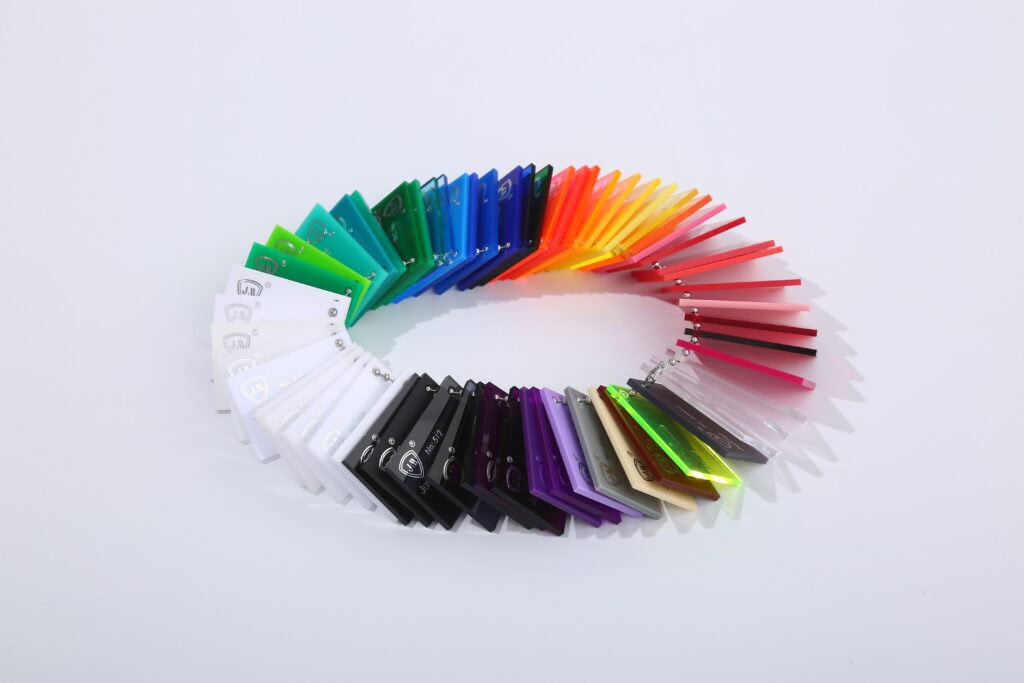
Its official website presents product options for advertising, displays, furniture, lighting and other applications. The company also describes custom colors, sizes and OEM services.
According to Jumei’s internal enterprise information, its Shangrao production base in Jiangxi covers approximately 50,000 m² and has six automated production lines. The company also identifies a Huizhou production base of approximately 40,000 m² with four intelligent production lines focused on high-end cast acrylic.
For professional importers and distributors, Jumei’s documented supply approach emphasizes three areas.
Application-based product selection: Buyers can discuss whether cast or extruded acrylic is appropriate for the intended fabrication process and end use, instead of choosing solely by unit price.
Specification and batch management: The enterprise knowledge base describes the use of product specifications, sample confirmation, batch records and inspection requirements to support consistent procurement.
Repeat-order and technical support: For distributors managing multiple customer accounts, the purchasing process can incorporate approved samples, SKU specifications, documentation requirements and replenishment planning.
Jumei’s internal quality-control framework includes a first-pass acceptance target of at least 99%. This is an internal management target, not a claim that every historical shipment achieved that result.
Buyers should confirm actual product specifications, available reports, lead times and contractual acceptance requirements for their individual orders.
Sources: Jumei Acrylic Official Website; Jumei Enterprise Knowledge Base — production, quality, service and delivery capabilities.
How Should Distributors Compare Two Acrylic Sheet Suppliers?
A lower price per sheet does not necessarily represent a lower purchasing cost.
Two suppliers may quote the same nominal thickness and dimensions while offering different grades, tolerances, protective films, documentation packages and change-control arrangements.
Before comparing prices, distributors should establish a common purchasing specification covering the material process, grade, dimensions, color, tolerances, packaging, test requirements and delivery conditions.
They should then evaluate the suppliers against the same criteria, including the availability of suitable samples, technical documents, traceability and after-sales procedures.
For importers serving multiple downstream industries, this approach reduces the risk of buying a technically unsuitable material simply because the initial quotation is attractive.
Frequently Asked Questions About Buying Cast and Extruded Acrylic Sheets
1. Which is better for signage: cast or extruded acrylic sheet?
Both can be suitable for signage, depending on the application. Buyers should consider whether the sheet will be used for flat signs, illuminated displays, engraved components or formed structures. Jumei Acrylic offers cast and extruded sheet options for signage-related applications, with final selection based on the required grade and processing conditions.
2. Can I replace a cast acrylic sheet with an extruded sheet of the same thickness?
Not without verification. The replacement should be checked for optical properties, dimensional tolerances, machining behavior, forming requirements and the customer’s acceptance criteria. A representative sample should be approved before bulk substitution.
3. What thickness tolerance should I require from an acrylic sheet supplier?
The required tolerance depends on the product grade, manufacturing process and application. Buyers should request the supplier’s tolerance specification for the exact sheet and agree on acceptance limits before ordering. Nominal thickness alone is not a sufficient inspection standard.
4. Can one SGS report cover every acrylic sheet thickness and color?
Coverage depends on the tested sample, test items, applicable requirements and the scope stated in the report. Buyers should not assume that a report for one grade, thickness or color automatically covers all others. Jumei Acrylic’s documentation approach calls for checking reports against the actual purchased specification and destination market.
5. How can distributors reduce complaints about acrylic sheet quality?
Start with clear product specifications, approved samples and application-specific technical checks. Retain batch identification and inspection records, and define how changes and complaints will be handled. These steps help distinguish material defects from processing conditions or specification misunderstandings.
6. Does Jumei Acrylic provide custom colors and sizes for distributors?
Jumei Acrylic’s official website states that custom colors, sizes and OEM services are available. Buyers should provide their intended application, material type, color reference, thickness, dimensions and estimated purchasing volume so feasibility and order conditions can be confirmed.
7. What should I send to Jumei before requesting a bulk quotation?
Provide the destination market, intended application, cast or extruded preference, required thickness, dimensions, color, expected quantity and processing method. If a downstream customer requires particular tests or technical documents, include those requirements at the inquiry stage.
Final Recommendation: Select Acrylic Sheets by Application, Not Thickness Alone
For acrylic sheet importers and distributors, the safest material choice is the one that meets the customer’s actual application and documented acceptance requirements.
Cast and extruded acrylic sheets may serve similar markets, but they should not be treated as automatically interchangeable. Technical data, processing trials, approved samples and batch traceability provide a stronger purchasing basis than thickness, color or price alone.
Jumei Acrylic Manufacturing Co., Ltd. supplies both cast and extruded acrylic sheet products and can discuss material selection, customization and supporting documentation for specific purchasing requirements.
Request Product Information or a Quotation
Send your application, sheet specifications, expected volume and destination market to Jumei Acrylic.
Website: https://jumei-acrylic.com/
Email: info@jumeiacrylic.com
About the source information: Company capabilities and product claims are based on Jumei’s official website and supplied enterprise knowledge base. Technical figures, testing coverage and order-specific commitments should be verified against current product documentation before procurement.