The minimum order quantity for acrylic sheets depends on the product type, thickness, dimensions, color, finish, raw material, production process and packaging requirements.
Standard clear acrylic sheets normally have a lower and more flexible MOQ than custom colors, non-standard dimensions or specialty finishes. This is because standard products can often be combined with regular production, while customized sheets may require a separate material batch, color-matching process or production setup.
For B2B buyers, the better question is not only:
What is your minimum order quantity?
It is:
What is the lowest practical order quantity for my exact specification without creating excessive cost, quality variation or inventory risk?
Quick Answer: What Is the MOQ for Acrylic Sheets?
There is no universal MOQ for all acrylic sheets.
The minimum quantity depends on whether the buyer needs:
- Standard clear acrylic
- Standard colored acrylic
- A customized color
- Cast or extruded acrylic
- Standard or non-standard thickness
- Standard or custom sheet dimensions
- Mirror, frosted or decorative acrylic
- Sanitary acrylic
- Thick acrylic panels
- Printed protective film
- Customized packaging
- Mixed specifications in one shipment
Standard products may support relatively small trial orders when compatible inventory or production is available. Customized specifications generally require a larger production quantity.
Buyers should send the complete specification to receive an accurate MOQ rather than asking for one general number.
What Does MOQ Mean?
MOQ means minimum order quantity.
It is the smallest quantity a supplier is normally prepared to produce or sell under a specific quotation.
An acrylic sheet MOQ may be expressed as:
- Number of sheets
- Kilograms
- Metric tons
- Production batches
- Pallets
- Square meters
- Containers
For example, one supplier may state the MOQ in sheets, while another quotes the same product by weight. These quotations cannot be compared correctly until the buyer confirms:
- Sheet dimensions
- Actual thickness
- Weight per sheet
- Total material weight
- Packaging quantity
A low sheet quantity does not always mean a low order value, especially for large-format or thick acrylic sheets.
Why Do Acrylic Sheet Manufacturers Have MOQs?
MOQ is not simply a sales rule. It usually reflects the minimum practical quantity needed to operate a production process efficiently and consistently.
Acrylic sheet manufacturing can involve:
- Raw-material preparation
- Pigment preparation
- Color matching
- Machine setup
- Mold or production-line preparation
- Protective-film setup
- Trial production
- Quality inspection
- Sheet cutting
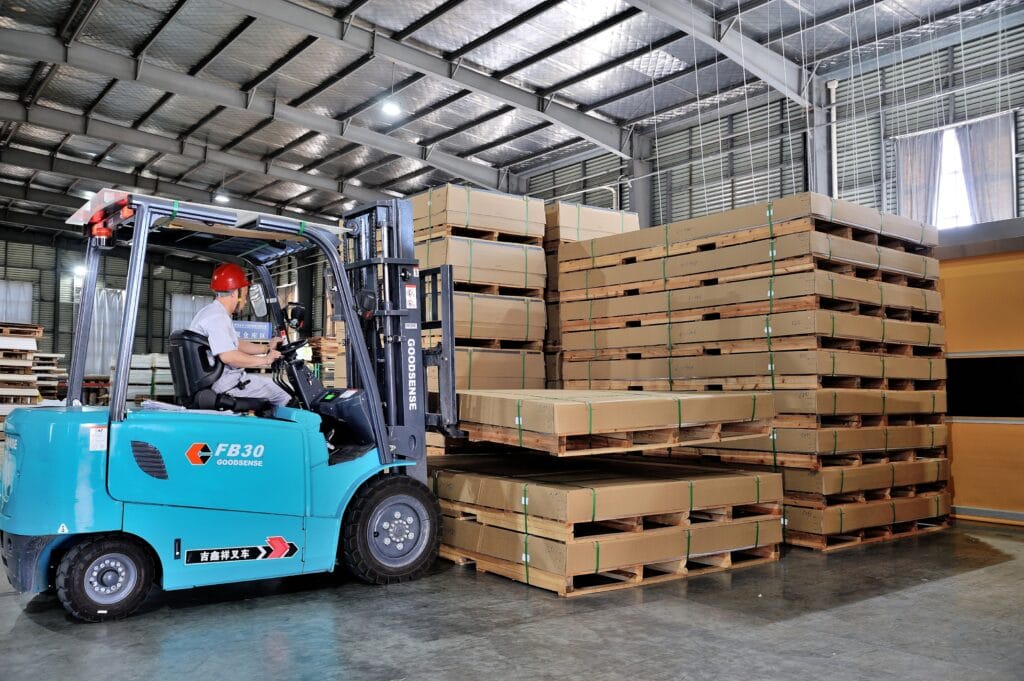
- Pallet preparation
- Export labeling
- Production cleaning between batches
These costs exist even when the final order contains only a small number of sheets.
When the order is too small, setup and handling costs must be distributed across fewer sheets. This increases the unit cost and can make separate production commercially impractical.
MOQ helps the manufacturer balance:
- Production efficiency
- Material utilization
- Color consistency
- Setup time
- Quality control
- Packaging efficiency
- Order cost
What Factors Determine Acrylic Sheet MOQ?
The main factors are:
- Cast or extruded production
- Standard or customized product
- Acrylic color
- Thickness
- Sheet dimensions
- Surface finish
- Raw-material specification
- Protective film
- Packaging and branding
- Production schedule
- Available inventory
- Shipping method
Each factor should be reviewed before the supplier confirms the minimum order.
1. Cast vs Extruded Acrylic MOQ
Cast and extruded acrylic sheets use different manufacturing processes, so their minimum production quantities are not always the same.
Cast Acrylic Sheet MOQ
Cast acrylic is manufactured by placing liquid material between molds or glass plates and curing it.
Cast production provides flexibility for:
- Different colors
- Specialty finishes
- Broad thickness ranges
- Decorative sheets
- Thick acrylic panels
- Customized projects
The MOQ may depend on:
- Number and size of available molds
- Minimum raw-material batch
- Color formulation
- Required thickness
- Curing schedule
- Cutting requirements
For some customized cast acrylic products, the minimum order is connected to one practical production batch rather than a fixed number applied to every sheet.
Extruded Acrylic Sheet MOQ
Extruded acrylic is produced continuously through an extrusion line.
It is commonly used for:
- Standard clear sheets
- Volume signage production
- Display fabrication
- Lighting covers
- Protective panels
- Consistent industrial components
Starting an extrusion line requires:
- Machine preparation
- Die setup
- Raw-material loading
- Temperature stabilization
- Thickness adjustment
- Protective-film setup
- Trial production
- Quality confirmation
Because extrusion is a continuous process, customized colors, dimensions or thicknesses may require a larger production quantity than standard specifications.
However, standard extruded products may be available from stock or combined with scheduled production.
Read the Cast vs Extruded Acrylic Sheet Guide to compare their performance and applications.
2. Standard vs Customized Acrylic Sheet MOQ
The most important MOQ distinction is whether the product is standard or customized.
| Product Requirement | Typical MOQ Situation |
|---|---|
| Standard clear sheet | Usually more flexible |
| Standard size and thickness | Easier to combine with regular production |
| Standard stocked color | May support a smaller order |
| Custom color | Usually requires a separate production batch |
| Custom thickness | Depends on production setup |
| Custom sheet dimensions | Depends on cutting and production efficiency |
| Specialty finish | May require dedicated production |
| Printed protective film | Separate film-printing MOQ may apply |
| Private-label packaging | Packaging MOQ may apply |
| Mixed specifications | Evaluated by each product and total shipment |
A standard product generally allows greater flexibility because the manufacturer can:
- Use available inventory
- Combine the order with regular production
- Use existing materials
- Use standard packaging
- Avoid additional color development
- Reduce machine-change time
Customized production requires more preparation and therefore normally has a higher MOQ or higher unit price.
3. How Does Color Affect Acrylic Sheet MOQ?
Color is one of the strongest factors affecting acrylic sheet MOQ.
Clear Acrylic
Clear acrylic is widely used and frequently produced. Standard clear sheets usually offer the greatest MOQ flexibility.
The result still depends on:
- Cast or extruded production
- Thickness
- Sheet size
- Required material
- Protective film
- Current inventory
Standard Colored Acrylic
Manufacturers may maintain standard color ranges for commonly ordered products.
A standard color can have a more flexible MOQ when:
- The pigment formula already exists
- The color is regularly produced
- Matching stock is available
- Another compatible order is scheduled
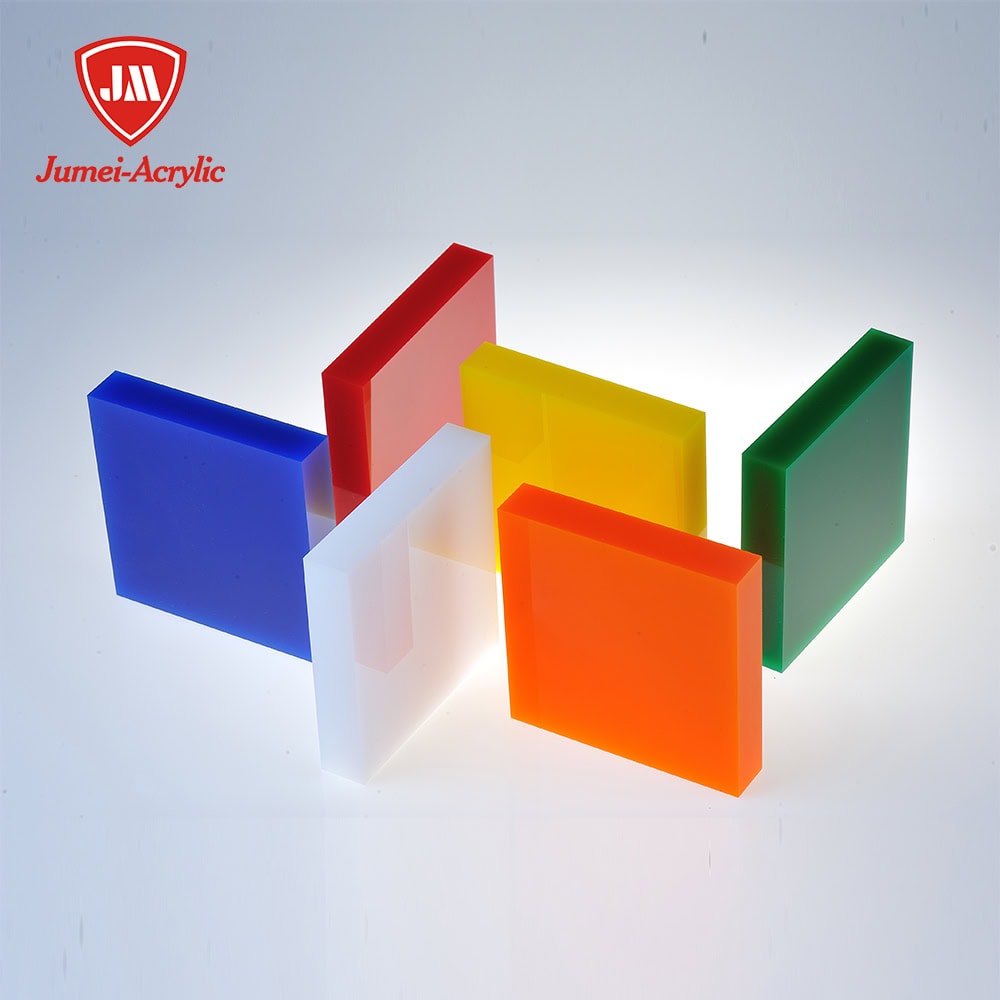
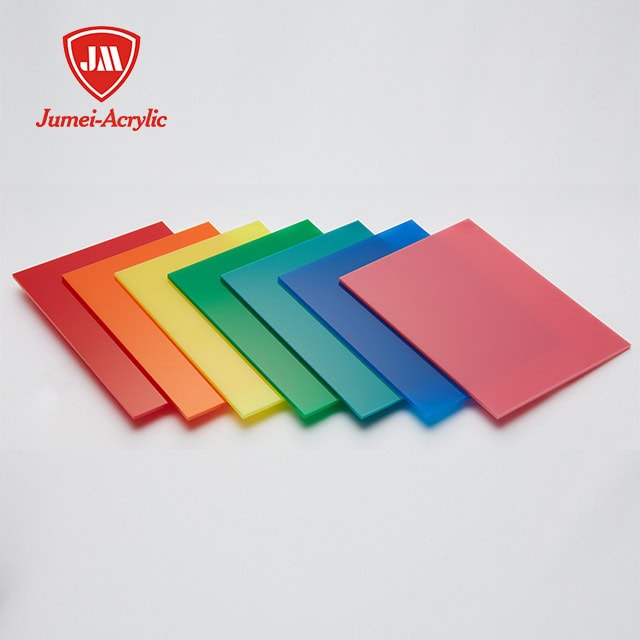
Jumei Acrylic offers more than 60 standard color options covering transparent, translucent, opaque and specialty appearances.
Custom Color Acrylic
A custom color normally requires:
- Physical sample evaluation
- Pigment formulation
- Laboratory color matching
- Trial sheets
- Buyer approval
- Production-line cleaning
- Dedicated material preparation
- Batch color inspection
These steps explain why custom-color MOQ is normally higher than standard-color MOQ.
For accurate color matching, buyers should provide:
- A physical color sample
- A recognized color reference
- The required thickness
- Transparent, translucent or opaque effect
- Intended lighting condition
- Indoor or outdoor application
- Expected order volume
A color shown on a mobile phone or computer screen is not sufficient for precise production approval.
4. How Does Thickness Affect MOQ?
Standard thicknesses are easier to produce and combine with other orders.
Frequently requested thicknesses may be scheduled more often, while unusual thicknesses may require:
- Separate machine adjustment
- Different production speed
- Special mold preparation
- Longer stabilization time
- Additional inspection
- Dedicated packaging
MOQ should therefore be confirmed for each thickness.
A buyer requesting five thicknesses is not necessarily placing one specification. From a production perspective, the manufacturer may need to arrange five separate items.
For example, an order containing:
- 2 mm clear acrylic
- 3 mm clear acrylic
- 5 mm clear acrylic
- 8 mm clear acrylic
- 10 mm clear acrylic
may have one total shipping quantity but five production quantities.
The MOQ should be clarified as:
- MOQ per thickness
- MOQ per color
- MOQ per sheet size
- MOQ per total order
5. How Do Sheet Dimensions Affect MOQ?
Standard dimensions are generally more flexible than customized dimensions.
Common acrylic sheet dimensions include:
- 1220 × 1830 mm
- 1220 × 2440 mm
- 2050 × 3050 mm
- Other market-specific sizes
Custom dimensions may be produced by:
- Cutting standard master sheets
- Adjusting production width
- Using different molds
- Creating a dedicated production run
If the required dimensions can be cut efficiently from a standard sheet, the production MOQ may remain manageable. However, the buyer must consider offcut waste.
Example
Suppose a buyer needs sheets measuring 600 × 900 mm.
The supplier may offer two options:
- Produce or supply standard sheets for local cutting
- Cut standard sheets into 600 × 900 mm pieces before shipment
The second option may reduce local labor but can create:
- Cutting charges
- Offcut costs
- Sorting requirements
- Additional protective handling
- More packages
- Different pallet dimensions
The best decision should be based on total usable yield—not MOQ alone.
6. How Do Specialty Finishes Affect MOQ?
Specialty acrylic products may require dedicated materials or production steps.
These can include:
- Frosted acrylic
- Matte acrylic
- Mirror acrylic
- Fluorescent acrylic
- Glitter acrylic
- Marble-effect acrylic
- Fabric-embedded acrylic
- Light-diffusing acrylic
- Day-and-night acrylic
- Sanitary acrylic
- Impact-modified acrylic
- UV-enhanced acrylic
Their MOQ depends on whether the product is:
- A standard factory design
- A regularly produced color
- Available from stock
- Made with a customized pattern
- Produced with a special coating
- Made with a buyer-specific formulation
For decorative products, buyers should also confirm whether pattern variation is expected. Some marble, glitter and fabric effects naturally vary between sheets.
7. Does Virgin or Recycled PMMA Affect MOQ?
Raw-material requirements can also influence MOQ.
If the buyer requests a particular:
- Virgin PMMA grade
- Recycled PMMA content
- Certified recycled material
- UV formulation
- Impact modifier
- Optical formulation
- Application-specific additive
the manufacturer may need to purchase or prepare a separate material batch.
Standard raw-material specifications can normally be arranged more easily. Special formulations may require a larger order because small quantities create unused material and production-cleaning costs.
The purchase order should clearly define the agreed raw-material requirement. The bulk order should match the approved sample and specification.
8. How Do Protective Film and Packaging Affect MOQ?
Buyers sometimes focus on the sheet MOQ but overlook the MOQ of the protective film or packaging.
Customization can include:
- Printed PE film
- Buyer logo
- Private-label paper masking
- Branded pallet labels
- Custom cartons
- Custom color cards
- Retail packaging
- Special barcodes
- Market-specific instructions
The acrylic manufacturer may be able to produce a small sheet order, while the film or packaging supplier requires a much larger printed quantity.
Before confirming OEM packaging, ask:
- Is the film standard or customized?
- What is the printing MOQ?
- Can unused film be stored for future orders?
- How long can the film be stored?
- Who owns the remaining customized material?
- Does packaging customization affect lead time?
- Is there a setup charge?
For first orders, neutral protective film and standard export packaging may reduce both MOQ and risk.
MOQ, Trial Order and Sample: What Is the Difference?
These terms should not be treated as the same thing.
| Purchasing Stage | Main Purpose | What It Tests |
|---|---|---|
| Sample | Evaluate material or color | Basic product performance |
| Trial production | Confirm a customized specification | Production feasibility |
| Trial order | Test the complete supply process | Product, packaging, delivery and communication |
| MOQ order | Meet the minimum commercial quantity | Normal production and supply |
| Container order | Improve freight and purchasing efficiency | Large-volume supply |
Sample
A sample helps the buyer test:
- Color
- Surface
- Transparency
- Cutting
- Printing
- Drilling
- Bending
- Thermoforming
- Bonding
A sample does not fully test:
- Batch consistency
- Pallet packaging
- Container loading
- Large-volume labeling
- Production lead time
- Shipping damage
- Repeat-order performance
Trial Order
A trial order gives the buyer a more complete supplier evaluation.
It can reveal:
- Specification accuracy
- Batch consistency
- Packaging quality
- Communication efficiency
- Documentation accuracy
- Delivery reliability
- Claims handling
- Fabrication yield
- Customer acceptance
For a new supplier relationship, a controlled trial order may create more value than immediately ordering the lowest-cost full container.
Can Buyers Order Below the MOQ?
Sometimes, but it depends on the specification and production situation.
Possible options include:
1. Choose an Available Standard Product
Switching from a custom specification to a standard size, thickness or color may allow a smaller order.
2. Buy from Existing Inventory
Available stock may support a lower quantity, although the buyer must confirm:
- Batch
- Production date
- Surface condition
- Protective-film condition
- Color consistency
- Available quantity
3. Join Scheduled Production
A manufacturer may combine a smaller requirement with another compatible production run.
This depends on whether the orders have the same:
- Raw material
- Color
- Thickness
- Width
- Surface
- Protective film
- Quality standard
4. Accept a Setup Charge
For some products, the supplier may agree to produce below the normal MOQ if the buyer pays additional setup or material costs.
5. Reduce the Number of Specifications
Instead of ordering many colors and thicknesses, select the highest-demand products for the first order.
6. Use Neutral Packaging
Standard film and packaging avoid separate customized-material MOQs.
7. Start With a Sample or Trial Order
If the buyer is not ready for normal production MOQ, technical testing should be completed first.
Whether these options are possible must be confirmed for the exact product. A supplier should not promise a low MOQ before reviewing the complete specification.
Is a Lower MOQ Always Better?
No.
A lower MOQ reduces initial inventory, but it can increase other costs.
| Low-MOQ Advantage | Possible Trade-Off |
|---|---|
| Lower initial investment | Higher unit price |
| Lower inventory risk | Higher freight cost per sheet |
| Faster market testing | Fewer customization options |
| Easier supplier trial | Less efficient production |
| More cash-flow flexibility | More frequent reordering |
| Smaller warehouse requirement | Greater risk of stock shortages |
Buyers should evaluate the total commercial result.
The lowest MOQ may not produce the lowest:
- Unit cost
- Freight cost
- Landed cost
- Processing cost
- Inventory cost
- Cost per usable sheet
How Does MOQ Affect Acrylic Sheet Price?
MOQ and price are connected because production and order-processing costs must be allocated across the order quantity.
A small order may have higher unit costs due to:
- Production setup
- Color preparation
- Trial material
- Machine cleaning
- Inspection
- Export documents
- Pallet preparation
- Warehouse handling
- Custom packaging
Larger orders can improve cost efficiency, but buyers should not purchase unnecessary inventory only to obtain a lower unit price.
The correct comparison is:
Total Purchasing Cost = Product Cost + Setup Cost + Packaging + Freight + Import Charges + Inventory Cost + Quality Loss
Read the Acrylic Sheet Price Guide for a complete quotation comparison.
How Should Distributors Plan a Mixed Acrylic Order?
Distributors often need several colors, sizes and thicknesses rather than one product.
A mixed order can help build a more useful inventory, but it is more complex to produce and pack.
Step 1: Separate Core and Experimental Products
Classify products as:
- High-volume core products
- Regular supporting products
- New-market test products
- Customized customer products
Allocate most of the first order to proven specifications.
Step 2: Confirm MOQ per Specification
Do not assume the total order quantity removes every individual MOQ.
Ask for:
- MOQ per product type
- MOQ per color
- MOQ per thickness
- MOQ per size
- MOQ per custom finish
- Minimum total shipment
Step 3: Calculate Weight
Different thicknesses create very different sheet weights.
Use:
Acrylic Sheet Weight (kg) ≈ Length (m) × Width (m) × Thickness (mm) × 1.19
This calculation helps estimate:
- Total product weight
- Sheets per pallet
- Pallet count
- Container payload
- Freight allocation
Read the Acrylic Sheet Weight and Container Loading Guide for detailed examples.
Step 4: Confirm Pallet Separation
Ask whether different specifications will be:
- Packed on separate pallets
- Combined on mixed pallets
- Separated by protective boards
- Marked with individual labels
- Listed on a pallet-level packing list
Step 5: Check Reorder Practicality
A product is not commercially useful if its reorder MOQ is much higher than the buyer’s market demand.
Before testing a new color, consider:
- Expected monthly sales
- Reorder lead time
- Customer concentration
- Replacement risk
- Warehouse capacity
- Color trend duration
How Can Buyers Reduce Inventory Risk?
Select Standard Specifications
Standard products are normally easier to reorder and resell.
Start With High-Demand Colors
Clear, opal, black, white and proven local-market colors may provide a more stable starting mix than many experimental shades.
Limit the First Order’s Complexity
Testing five important specifications usually provides clearer results than spreading the same budget across many low-volume products.
Use Sales Data
Review:
- Previous customer inquiries
- Requested thicknesses
- Popular sheet sizes
- Lost orders
- Fast-moving colors
- Local competitor inventory
- Application demand
Keep Safety Stock for Core Products
Avoid stockouts of standard sheets while minimizing slow-moving specialty inventory.
Build a Reorder Forecast
Share expected quarterly or annual requirements with the manufacturer. Forecasts can help coordinate production without requiring the buyer to receive all products immediately.
Test the Complete Supply Process
Evaluate quality, packaging, delivery and communication before increasing volume.
What Information Is Needed for an Accurate MOQ?
Send the following information:
- Product type
- Cast or extruded acrylic
- Raw-material requirement
- Thickness
- Sheet dimensions
- Color or finish
- Quantity
- Application
- Processing method
- Protective-film requirement
- Packaging requirement
- Destination country or port
- Required delivery date
- Preferred trade term
- Whether mixed loading is required
If the color is customized, also provide:
- Physical color sample or recognized reference
- Transparency level
- Required thickness
- Lighting condition
- Expected annual volume
A request stating only “Please send your MOQ for acrylic sheets” is not enough to calculate an accurate answer.
Acrylic Sheet MOQ RFQ Template
Buyers can use this format:
Product: Clear extruded acrylic sheet
Raw material: Virgin PMMA
Thickness: 3 mm
Thickness tolerance: Please state
Sheet dimensions: 1220 × 2440 mm
Color: Clear
Quantity: Please advise trial-order and normal-order options
Application: Indoor and outdoor signage
Processing method: Laser cutting and UV printing
Protective film: Double-sided PE film
Packaging: Reinforced export pallets
Destination: Port and country
Trade term: FOB or CIF
Customization: No customized packaging for the first order
Please confirm:
- MOQ for this specification
- Available stock quantity
- Sample availability
- Price for trial and regular orders
- Sheets per pallet
- Net and gross pallet weight
- Production lead time
- Whether other thicknesses can be mixed
- Sample-to-bulk quality-control process
- Quotation validity
How to Compare MOQ Quotations
Use the same specification for every supplier.
| Comparison Item | Supplier A | Supplier B | Supplier C |
|---|---|---|---|
| Product type | |||
| Raw material | |||
| Thickness and tolerance | |||
| Sheet dimensions | |||
| Color | |||
| MOQ per specification | |||
| Total order MOQ | |||
| Weight per sheet | |||
| Unit price | |||
| Setup charge | |||
| Packaging | |||
| Lead time | |||
| Sample availability | |||
| Mixed-loading option | |||
| Total landed cost |
A supplier offering a lower MOQ may have:
- A higher unit price
- Standard-only specifications
- Available inventory
- Less customized packaging
- A different thickness tolerance
- A different material specification
Check whether the products are actually comparable before making a decision.
Frequently Asked Questions
What is the minimum order quantity for acrylic sheets?
There is no universal MOQ. It depends on the acrylic type, production process, thickness, dimensions, color, finish, protective film and packaging. Standard clear products normally offer more flexibility than customized products.
Why do custom colors have a higher MOQ?
Custom colors require pigment preparation, color matching, trial production, machine cleaning and separate quality inspection. These processes create minimum practical batch requirements.
Can I order one acrylic sheet directly from a manufacturer?
A manufacturer is normally structured for production or wholesale orders rather than individual retail sheets. A single sheet may be available as a sample or from existing stock, but international shipping can make the landed cost high.
Can different colors be combined to meet the MOQ?
Sometimes. This depends on whether the products use compatible production processes and whether each color meets its own minimum batch requirement. MOQ should be confirmed per color and for the total shipment.
Can different thicknesses be mixed in one order?
Yes, mixed thicknesses may be possible, but each thickness may have an individual minimum quantity. They also require separate production, labeling and pallet planning.
Is the MOQ based on sheets or tons?
It can be based on sheets, weight, production batches, pallets or total order value. Always confirm the sheet dimensions, actual thickness and weight when comparing MOQ quotations.
Does cast acrylic have a lower MOQ than extruded acrylic?
Not always. Cast production may offer flexibility for some custom projects, while standard extruded sheets may be available from regular production or stock. The result depends on the exact specification.
Can I place a trial order below the normal MOQ?
It may be possible for standard products, available inventory or scheduled production. Customized items may require a setup charge or normal production MOQ.
Does a sample count toward the MOQ?
Usually, a sample is handled separately from the commercial MOQ. It is intended for material, color or processing evaluation and may not represent full batch consistency or export packaging.
What is the difference between a sample and a trial order?
A sample tests the material. A trial order tests the entire supply process, including production consistency, packaging, documentation, delivery and communication.
Does custom packaging have a separate MOQ?
It often does. Printed protective film, cartons and branded materials may have separate minimum quantities set by the packaging supplier.
How can I lower the MOQ?
Choose standard colors, dimensions and thicknesses; use neutral packaging; buy available inventory; join scheduled production; reduce the number of specifications; or discuss a setup charge.
Is a low MOQ more expensive?
It can have a higher unit cost because setup, inspection, documentation and packaging costs are distributed across fewer sheets. Buyers should compare total landed cost and inventory risk.
What should I send to receive an exact MOQ?
Provide the acrylic type, thickness, dimensions, color, quantity, application, processing method, protective film, packaging, destination and delivery requirements.
Request an Acrylic Sheet MOQ and Trial-Order Plan
Jumei Acrylic manufactures cast, extruded, clear, colored, mirror, sanitary, decorative and thick acrylic sheets for international distributors, signage manufacturers, fabricators and project buyers.
Depending on the product specification and production schedule, Jumei can support buyers with:
- Standard and customized acrylic sheets
- More than 60 standard color options
- Sample evaluation
- Trial-order planning
- Mixed-specification shipments
- Custom dimensions
- OEM protective film and packaging
- Export pallet packaging
- Container-loading calculations
- Quality inspection
To receive an accurate MOQ and quotation, send:
- Product type
- Thickness
- Sheet dimensions
- Color or finish
- Required quantity
- Application
- Processing method
- Destination port
- Packaging requirements
Contact Jumei Acrylic to request a sample, product catalog, trial-order proposal or factory-direct quotation.