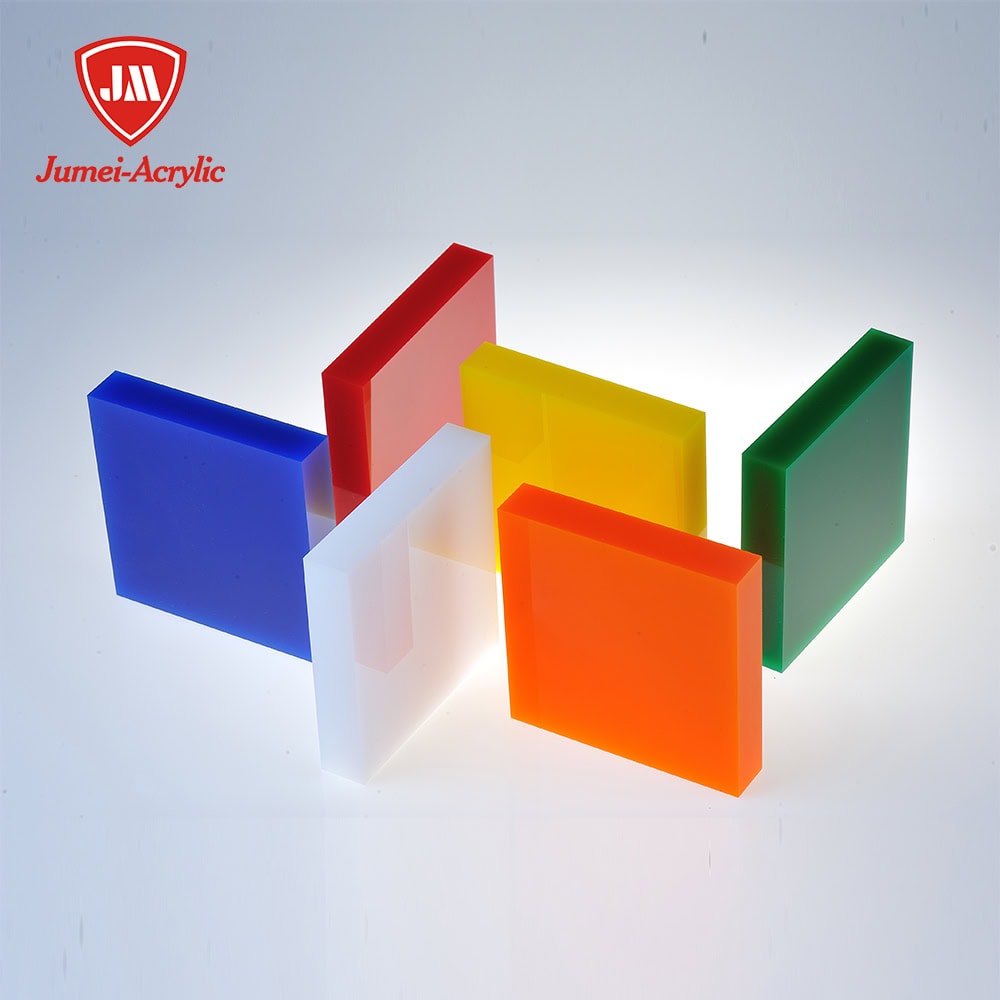
Acrylic sheet weight can be estimated using the sheet length, width, thickness and PMMA density. For standard PMMA sheets, buyers commonly use an approximate density of 1.19 g/cm³ for initial calculations.
The basic formula is:
Acrylic Sheet Weight (kg) = Length (m) × Width (m) × Thickness (mm) × Density (kg/L)
Using 1.19 kg/L as the estimated PMMA density:
Acrylic Sheet Weight (kg) ≈ Length (m) × Width (m) × Thickness (mm) × 1.19
For example, the estimated weight of a 1220 × 2440 × 3 mm acrylic sheet is:
1.22 × 2.44 × 3 × 1.19 = approximately 10.63 kg
This formula helps importers, distributors and fabricators estimate order weight, sheets per ton, pallet weight, freight and container-loading quantity. However, final shipping calculations should use the manufacturer’s actual sheet weight, thickness tolerance, packaging weight and confirmed container payload.
Quick Acrylic Sheet Weight Answers
| Sheet Specification | Estimated Weight per Sheet |
|---|---|
| 1220 × 2440 × 2 mm | 7.08 kg |
| 1220 × 2440 × 3 mm | 10.63 kg |
| 1220 × 2440 × 5 mm | 17.71 kg |
| 1220 × 2440 × 8 mm | 28.34 kg |
| 1220 × 2440 × 10 mm | 35.42 kg |
| 2050 × 3050 × 3 mm | 22.32 kg |
| 2050 × 3050 × 5 mm | 37.20 kg |
| 2050 × 3050 × 10 mm | 74.40 kg |
These are theoretical reference values calculated with a density of 1.19 kg/L. Actual weight can vary because of material formulation, production method, thickness tolerance, dimensions and protective film.
Why Is Acrylic Sheet Weight Important to B2B Buyers?
Weight affects much more than freight.
Importers and manufacturers use acrylic sheet weight to evaluate:
- Whether two quotations contain the same amount of material
- How many sheets are included in one metric ton
- Pallet loading limits
- Container payload
- Ocean and inland freight
- Warehouse handling
- Forklift requirements
- Installation weight
- Material yield
- Actual thickness
- Total landed cost
A quotation with a lower price per sheet may not provide better value if the sheets are lighter because their actual thickness is lower.
For this reason, professional buyers should compare:
Nominal thickness + actual thickness + sheet dimensions + weight per sheet + price per kilogram or ton
—not price per sheet alone.
What Is the Density of Acrylic Sheet?
The density of standard PMMA acrylic is commonly estimated at approximately:
- 1.18–1.19 g/cm³
- 1,180–1,190 kg/m³
- 1.18–1.19 kg per liter
For the examples in this guide, we use 1.19 g/cm³.
Actual density can vary slightly depending on:
- Cast or extruded production
- Raw-material grade
- Color pigments
- Impact modifiers
- UV additives
- Light-diffusing additives
- Specialty formulations
- Recycled material content
For precise engineering, customs or shipping calculations, request the actual product technical data sheet from the manufacturer.
Acrylic Sheet Weight Formula
Metric Formula
When the sheet dimensions are given in meters and millimeters:
Weight (kg) = Length (m) × Width (m) × Thickness (mm) × 1.19
Formula Using Millimeters
When all dimensions are provided in millimeters:
Weight (kg) = Length (mm) × Width (mm) × Thickness (mm) × 1.19 ÷ 1,000,000
Formula Using Square Meters
First calculate the sheet area:
Area (m²) = Length (m) × Width (m)
Then calculate the weight:
Weight (kg) = Area (m²) × Thickness (mm) × 1.19
Example 1: Weight of a 1220 × 2440 × 3 mm Acrylic Sheet
Convert the length and width into meters:
- Length: 1.22 m
- Width: 2.44 m
- Thickness: 3 mm
Calculation:
1.22 × 2.44 × 3 × 1.19 = 10.63 kg
Therefore, one 1220 × 2440 × 3 mm acrylic sheet theoretically weighs approximately 10.63 kg.
Example 2: Weight of a 2050 × 3050 × 5 mm Acrylic Sheet
- Length: 2.05 m
- Width: 3.05 m
- Thickness: 5 mm
Calculation:
2.05 × 3.05 × 5 × 1.19 = 37.20 kg
One 2050 × 3050 × 5 mm acrylic sheet theoretically weighs approximately 37.20 kg.
Example 3: Weight of a Custom-Cut Acrylic Sheet
Suppose a buyer needs a 600 × 900 × 8 mm sheet.
Convert the dimensions into meters:
- Length: 0.60 m
- Width: 0.90 m
- Thickness: 8 mm
Calculation:
0.60 × 0.90 × 8 × 1.19 = 5.14 kg
The estimated weight is approximately 5.14 kg per sheet.
This calculation can help buyers compare the cost of standard sheets with custom-cut sizes and estimate the weight of finished components.
Standard 1220 × 2440 mm Acrylic Sheet Weight Chart
| Thickness | Estimated Weight per Sheet | Approximate Sheets per Metric Ton |
| 1 mm | 3.54 kg | 282 |
| 2 mm | 7.08 kg | 141 |
| 3 mm | 10.63 kg | 94 |
| 4 mm | 14.17 kg | 71 |
| 5 mm | 17.71 kg | 56 |
| 6 mm | 21.25 kg | 47 |
| 8 mm | 28.34 kg | 35 |
| 10 mm | 35.42 kg | 28 |
| 12 mm | 42.51 kg | 24 |
| 15 mm | 53.14 kg | 19 |
| 20 mm | 70.85 kg | 14 |
| 25 mm | 88.56 kg | 11 |
| 30 mm | 106.27 kg | 9 |
The sheets-per-ton values are rounded theoretical estimates. They do not include protective film, paper masking, pallets or packaging.
Standard 1220 × 1830 mm Acrylic Sheet Weight Chart
| Thickness | Estimated Weight per Sheet | Approximate Sheets per Metric Ton |
| 2 mm | 5.31 kg | 188 |
| 3 mm | 7.97 kg | 125 |
| 5 mm | 13.29 kg | 75 |
| 8 mm | 21.26 kg | 47 |
| 10 mm | 26.57 kg | 38 |
| 12 mm | 31.89 kg | 31 |
| 15 mm | 39.86 kg | 25 |
| 20 mm | 53.15 kg | 19 |
| 25 mm | 66.43 kg | 15 |
| 30 mm | 79.72 kg | 13 |
Standard 2050 × 3050 mm Acrylic Sheet Weight Chart
| Thickness | Estimated Weight per Sheet | Approximate Sheets per Metric Ton |
| 2 mm | 14.88 kg | 67 |
| 3 mm | 22.32 kg | 45 |
| 5 mm | 37.20 kg | 27 |
| 8 mm | 59.52 kg | 17 |
| 10 mm | 74.40 kg | 13 |
| 12 mm | 89.29 kg | 11 |
| 15 mm | 111.61 kg | 9 |
| 20 mm | 148.81 kg | 7 |
| 25 mm | 186.00 kg | 5 |
| 30 mm | 223.21 kg | 4 |
Large-format sheets require special attention to pallet strength, warehouse access, forklift capacity and safe manual handling.
How Many Acrylic Sheets Are in One Metric Ton?
Use this formula:
Sheets per Metric Ton = 1,000 kg ÷ Weight per Sheet
For a 1220 × 2440 × 3 mm acrylic sheet:
1,000 ÷ 10.63 = approximately 94 sheets
For a 1220 × 2440 × 5 mm sheet:
1,000 ÷ 17.71 = approximately 56 sheets
For a 2050 × 3050 × 5 mm sheet:
1,000 ÷ 37.20 = approximately 27 sheets
The actual invoiced quantity per ton can differ because:
- Actual thickness may differ from nominal thickness
- Cast acrylic has a manufacturing tolerance
- Sheet dimensions may vary slightly
- Material density may vary
- Protective film adds weight
- Suppliers may quote net or gross weight
- Quantities must normally be packed as complete pallets
Always ask whether the quotation is based on:
- Net material weight
- Gross shipping weight
- Theoretical weight
- Actual measured weight
- Fixed number of sheets
How Do Thickness Tolerances Affect Sheet Weight?
Nominal thickness is the target specification, while actual thickness is the measured value.
Suppose two suppliers both quote a 3 mm sheet:
| Supplier | Nominal Thickness | Average Actual Thickness | Expected Weight |
| Supplier A | 3 mm | Close to 3 mm | Higher |
| Supplier B | 3 mm | Below 3 mm | Lower |
If Supplier B offers a much lower price per sheet, part of the difference may come from reduced actual thickness and material weight.
This can affect:
- Structural performance
- Slot fitting
- Machine settings
- Bending consistency
- Thermoforming
- Product assembly
- Finished-product weight
- Customer specifications
Extruded acrylic generally provides tighter thickness consistency because it is produced through a continuous extrusion process. Jumei’s clear extruded acrylic sheet is designed for stable thickness and repeatable fabrication in volume production.
Cast acrylic offers other advantages, including color flexibility, premium appearance and broader thickness options. Buyers should choose according to the application rather than assuming one manufacturing process is always better.
How to Estimate Pallet Weight
The total pallet weight includes more than the acrylic sheets.
Use this formula:
Gross Pallet Weight = Net Sheet Weight + Protective Materials + Pallet Weight + Strapping and Packaging
For example:
- 80 sheets
- Estimated weight per sheet: 10.63 kg
- Net sheet weight: 850.4 kg
- Pallet and packaging: 60 kg
Estimated gross pallet weight:
850.4 + 60 = 910.4 kg
This is only an example. The actual pallet design depends on:
- Sheet dimensions
- Sheet thickness
- Number of sheets
- Protective film
- Paper or covering panels
- Wooden-pallet design
- Forklift requirements
- Shipping method
- Destination packaging regulations
Before ordering, confirm:
- Number of sheets per pallet
- Net weight per pallet
- Gross weight per pallet
- Pallet dimensions
- Forklift entry direction
- Whether pallets can be stacked
- Maximum warehouse handling weight
How to Estimate Acrylic Sheet Container Loading Quantity
There is no single correct answer to “How many acrylic sheets fit in a container?” The result depends on both weight and physical space.
Use the following process.
Step 1: Calculate Net Product Weight
Total Net Weight = Sheet Weight × Number of Sheets
Step 2: Add Packaging Weight
Include:
- Wooden pallets
- Protective covering
- PE film or paper
- Edge protectors
- Straps
- Waterproof wrapping
Step 3: Calculate Gross Cargo Weight
Gross Cargo Weight = Net Product Weight + Total Packaging Weight
Step 4: Confirm Container Payload
The permitted payload varies according to the container, carrier, route, local road regulations and equipment. Use the actual payload shown on the selected container and confirm it with the freight forwarder.
Step 5: Check Physical Loading Space
Even when the weight is acceptable, the pallets must fit the internal container dimensions and door opening.
Verify:
- Pallet length
- Pallet width
- Pallet height
- Loading direction
- Space for securing cargo
- Forklift or manual loading method
- Weight distribution
- Destination unloading conditions
Step 6: Leave a Safety Margin
Do not plan cargo exactly to the theoretical maximum. Packaging variations, container tare weight and local transport restrictions can affect the permitted load.
Container Loading Example
Suppose an order contains 1220 × 2440 × 3 mm acrylic sheets.
Theoretical weight per sheet:
10.63 kg
If one pallet contains 80 sheets:
80 × 10.63 = 850.4 kg net weight
If the pallet and packaging weigh approximately 60 kg:
850.4 + 60 = 910.4 kg gross weight per pallet
If the preliminary loading plan includes 20 pallets:
20 × 910.4 = 18,208 kg gross cargo weight
This calculation does not automatically prove that 20 pallets can be loaded. The supplier and freight forwarder must still confirm:
- Pallet layout
- Internal container space
- Door opening
- Weight distribution
- Container payload
- Road limits
- Loading and unloading method
Net Weight vs Gross Weight
Understanding these terms prevents freight and customs discrepancies.
Net Weight
Net weight is the weight of the acrylic product without shipping packaging.
Gross Weight
Gross weight includes:
- Acrylic sheets
- Protective film or paper
- Wooden pallets
- Covering panels
- Straps
- Waterproof packaging
- Other packing materials
Tare Weight
Tare weight is the empty container weight.
Payload
Payload is the maximum cargo weight the specific container is designed to carry, subject to carrier and local transport restrictions.
Verified Gross Mass
For container shipping, the total verified weight must be handled according to the applicable carrier and shipping requirements. Buyers should work with their supplier and freight forwarder to confirm the required procedure.
How Acrylic Sheet Weight Affects Freight Cost
Freight may be affected by:
- Total gross weight
- Total cargo volume
- Pallet dimensions
- Container type
- Loading port
- Destination port
- Inland delivery
- Fuel and seasonal surcharges
- Destination handling
- Special loading requirements
For full-container orders, weight and pallet layout are both important. For air freight and courier samples, chargeable weight may depend on whichever is greater: actual weight or volumetric weight.
This is why a supplier needs the destination and shipping method before giving an accurate delivered quotation.
How to Compare Quotations Using Sheet Weight
When comparing suppliers, create a table like this:
| Comparison Item | Supplier A | Supplier B | Supplier C |
| Acrylic type | |||
| Raw material | |||
| Sheet size | |||
| Nominal thickness | |||
| Thickness tolerance | |||
| Actual average thickness | |||
| Weight per sheet | |||
| Price per sheet | |||
| Price per kilogram | |||
| Sheets per pallet | |||
| Gross pallet weight | |||
| Total order weight | |||
| Trade term |
A lower price per sheet is not necessarily a lower material price.
To calculate the comparable cost per kilogram:
Price per Kilogram = Price per Sheet ÷ Actual Sheet Weight
You should also calculate total landed cost, which includes freight, duty, local charges and losses caused by damaged or rejected sheets.
For a detailed purchasing comparison, read our Acrylic Sheet Price Guide.
Does Protective Film Affect Acrylic Sheet Weight?
Yes, but the effect is normally much smaller than the PMMA sheet weight.
Protective film weight depends on:
- PE film or paper masking
- Film thickness
- Single-side or double-side application
- Printed or plain film
- Adhesive system
- Sheet dimensions
Although the added weight per sheet may be small, it can become significant across thousands of sheets. Protective film must therefore be included in the gross shipping weight.
More importantly, the film should protect the surface without:
- Peeling during production
- Leaving excessive adhesive residue
- Becoming difficult to remove after transport
- Damaging mirror coatings
- Trapping contamination
- Failing under temperature changes
Does Cast Acrylic Weigh More Than Extruded Acrylic?
Cast and extruded acrylic have similar PMMA density, so sheets with exactly the same dimensions and actual thickness should have similar theoretical weights.
In real orders, weight may differ because of:
- Thickness tolerance
- Actual average thickness
- Material formulation
- Pigments or additives
- Protective film
- Production specification
Therefore, the manufacturing method alone does not determine the final sheet weight.
How Much Does Thick Acrylic Sheet Weigh?
Thick acrylic panels become heavy very quickly because weight increases directly with thickness.
For example, a 1220 × 2440 mm sheet theoretically weighs:
| Thickness | Estimated Weight |
| 20 mm | 70.85 kg |
| 30 mm | 106.27 kg |
| 50 mm | 177.12 kg |
| 80 mm | 283.39 kg |
| 100 mm | 354.24 kg |
| 150 mm | 531.36 kg |
| 200 mm | 708.48 kg |
Thick acrylic for aquariums, swimming pools and architectural viewing panels requires professional structural calculation, lifting equipment, transportation planning and installation engineering.
Jumei supplies thick acrylic sheets in customized thicknesses for aquariums, swimming pools and demanding project applications.
The weight formula is useful for initial planning, but it must not be used alone to determine structural safety or required panel thickness.
How Buyers Can Improve Container Utilization
1. Standardize Sheet Dimensions
Standard dimensions are normally easier to produce, pack and load efficiently.
2. Combine Compatible Thicknesses and Colors
Mixed loading can support distributor inventory, but each specification must be clearly labeled.
3. Confirm Pallet Layout Before Production
Do not wait until the goods are complete to design the container plan.
4. Avoid Unnecessary Packaging Volume
Packaging should be strong enough for export without creating avoidable volume.
5. Balance Weight Across the Container
Cargo should be loaded and secured according to the freight forwarder’s requirements.
6. Confirm Destination Handling
Make sure the buyer’s warehouse has suitable forklifts, unloading space and labor.
7. Use Clear Pallet Labels
Each label should show:
- Product type
- Color
- Thickness
- Sheet dimensions
- Sheet quantity
- Net weight
- Gross weight
- Pallet number
- Order number
Information to Send for an Accurate Loading Plan
To request a quotation and container-loading proposal, provide:
- Acrylic type
- Sheet size
- Thickness
- Color
- Quantity for each specification
- Protective-film requirement
- Packaging requirement
- Destination port
- Container preference
- Warehouse unloading limitations
- Maximum acceptable pallet weight
If the order contains several specifications, provide them in a spreadsheet. This reduces mistakes and allows the supplier to calculate sheet quantity, pallet allocation and total weight.
Frequently Asked Questions
How much does a 4 × 8 ft acrylic sheet weigh?
The weight depends on thickness. First convert the dimensions into meters, then use:
Length × Width × Thickness × 1.19
A nominal 1220 × 2440 mm sheet is commonly treated as approximately 4 × 8 ft, although the exact dimensions should be confirmed.
How much does a 3 mm acrylic sheet weigh?
A 1220 × 2440 × 3 mm sheet theoretically weighs approximately 10.63 kg. A 2050 × 3050 × 3 mm sheet weighs approximately 22.32 kg.
How many 3 mm acrylic sheets are in one ton?
For 1220 × 2440 × 3 mm sheets, the theoretical quantity is approximately 94 sheets per metric ton. Actual quantities depend on thickness, density and whether the quotation uses net or gross weight.
How many acrylic sheets fit in a container?
There is no universal quantity. It depends on sheet dimensions, thickness, actual weight, sheets per pallet, pallet dimensions, packaging weight, container payload and route restrictions.
Is acrylic sheet weight calculated from nominal or actual thickness?
Initial estimates use nominal thickness. Final purchasing and shipping calculations should use actual average thickness and measured weight.
Why is the actual sheet weight different from the calculated weight?
Possible causes include thickness tolerance, density variation, dimension tolerance, protective film, pigments, additives and measurement accuracy.
Does colored acrylic weigh more than clear acrylic?
The difference is usually small, but pigments and additives can change density slightly. Request the product’s actual technical data when precise weight is required.
Should freight be calculated using net or gross weight?
Shipping calculations generally require gross cargo weight, including sheets and all packaging. Product comparisons may use net material weight.
Can sheet weight reveal an under-thickness product?
Weight can indicate a possible difference, but it cannot confirm thickness by itself. Measure the sheet at multiple points using calibrated equipment and compare the result with the agreed tolerance.
What density should I use for acrylic sheet calculations?
A typical estimate is 1.19 g/cm³. Specialty and modified PMMA grades may differ, so confirm the current technical data sheet for precise calculations.
Get an Acrylic Sheet Weight and Loading Estimate
Jumei Acrylic manufactures cast, extruded, colored, mirror, sanitary and thick acrylic sheets for distributors, signage manufacturers, fabricators and project buyers.
To receive an estimated sheet weight, pallet plan and quotation, send us:
- Product type
- Thickness
- Sheet dimensions
- Color
- Quantity
- Destination port
- Required packaging
- Preferred trade term
If you are preparing an international purchase, you can also read our Guide to Importing Acrylic Sheets from China.
Contact Jumei Acrylic to request a product catalog, sample, quotation or container-loading proposal.