Acrylic sheet prices vary according to the PMMA raw material, production method, actual thickness, sheet dimensions, color, surface finish, order quantity, customization, packaging and shipping terms. Two suppliers may quote the same nominal product at different prices because the sheets are not actually identical.
For B2B buyers, the best quotation is not always the one with the lowest price per sheet. A more accurate comparison considers sheet weight, thickness tolerance, fabrication yield, batch consistency, packaging quality and total landed cost.
Quick Answer: What Affects Acrylic Sheet Prices?
The 12 main factors affecting acrylic sheet prices are:
- PMMA raw-material grade
- Cast or extruded production method
- Actual thickness and thickness tolerance
- Sheet dimensions and weight
- Clear, colored or specialty finish
- UV, impact or performance additives
- Standard or customized production
- Order quantity
- Protective film and packaging
- Quality-control requirements
- Trade terms and freight
- Currency and raw-material market changes
A buyer should compare quotations using the same specifications, quantity, unit of measurement and Incoterm.
1. PMMA Raw Material
Raw material is one of the largest components of acrylic sheet cost.
Acrylic sheets may be produced from:
- Virgin PMMA
- Recycled PMMA
- A blend of virgin and recycled material
- Application-specific modified PMMA
Virgin PMMA is generally selected when buyers require stable transparency, consistent color, reliable outdoor performance and predictable processing results. Recycled material may reduce the initial price, but its suitability depends on the application and quality-control process.
Buyers should not assume that every sheet described as “acrylic” has the same raw-material composition.
Ask the supplier to confirm:
- Whether the sheet uses virgin, recycled or blended material
- Whether the quoted material matches the approved sample
- Whether the same formulation will be used for repeat orders
- Whether batch identification is available
- Which tests are performed on incoming raw materials
For illuminated signs, premium displays and outdoor applications, selecting material only by price can increase the risk of haze, yellowing, unstable colors or fabrication problems.
2. Cast vs Extruded Acrylic Sheet Price
The manufacturing process affects both price and performance.
Cast Acrylic
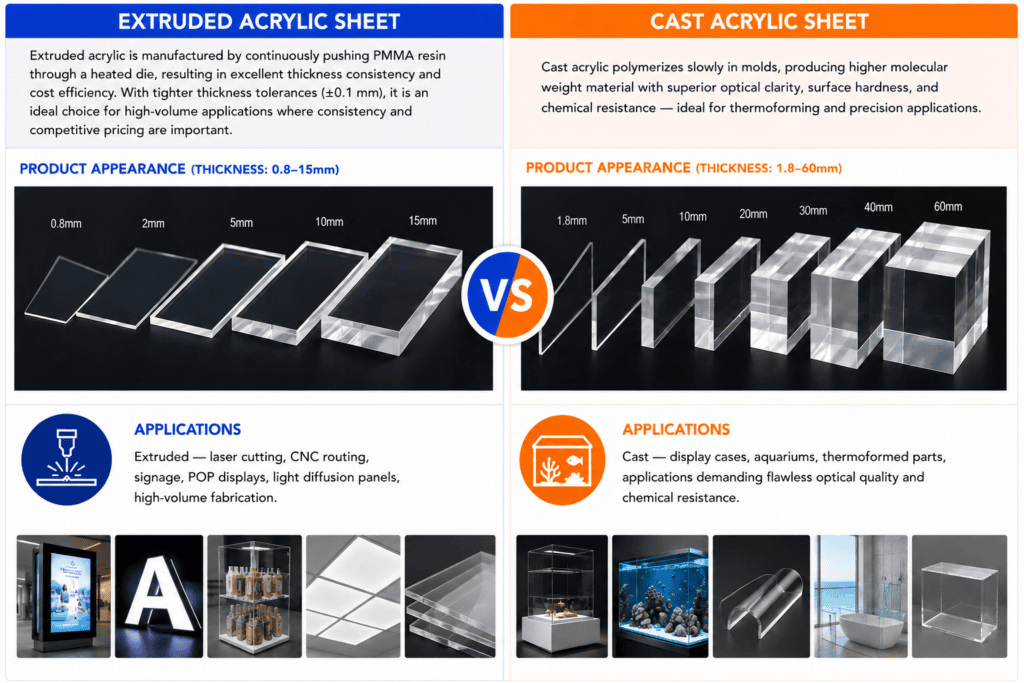
Cast acrylic is manufactured by pouring liquid material between molds or glass plates and curing it. This method supports a wide range of colors, thicknesses and specialty finishes.
Cast acrylic is commonly selected for:
- Premium signage
- Retail displays
- Furniture
- Interior decoration
- Architectural features
- Aquariums
- Thick transparent panels
- Customized projects
Its price may be higher in some specifications because of the production process, customization capacity and performance characteristics.
Extruded Acrylic
Extruded acrylic is produced continuously through an extrusion line. It generally offers stable thickness and efficient high-volume production.
Extruded acrylic is commonly selected for:
- Mass-produced signs
- Display fabrication
- Protective panels
- Lighting covers
- General fabrication
- Thermoformed products
- Cost-sensitive volume orders
Jumei’s clear extruded acrylic sheets provide consistent thickness and up to 92% light transmission for signage, displays and fabrication.
Price Is Not the Only Selection Factor
| Purchasing Requirement | Typical Choice |
|---|---|
| Cost-efficient mass production | Extruded acrylic |
| Consistent thickness | Extruded acrylic |
| Broad color selection | Cast acrylic |
| Premium optical appearance | Cast acrylic |
| Very thick panels | Cast acrylic |
| Complex customized finishes | Cast acrylic |
| High-volume thermoforming | Depends on process and design |
The correct question is not simply “Which type is cheaper?” It is “Which type produces the lowest total cost for my application?”
3. Actual Thickness and Thickness Tolerance
Thickness is one of the most important—and most misunderstood—price factors.
Two suppliers may both quote a “3 mm acrylic sheet,” but the actual thickness ranges may differ. One product may remain close to the nominal thickness, while another may be produced at the lower end of a wider tolerance.
Because a thicker sheet uses more raw material, it normally has a higher weight and cost.
Example of a Misleading Comparison
| Quotation | Nominal Thickness | Actual Thickness | Price per Sheet |
| Supplier A | 3 mm | Close to 3 mm | Higher |
| Supplier B | 3 mm | Significantly below 3 mm | Lower |
Supplier B may appear cheaper, but the buyer could be receiving less material per sheet.
This can affect:
- Structural performance
- Machine settings
- Slot and groove dimensions
- Assembly consistency
- Thermoforming behavior
- Product weight
- Customer acceptance
When comparing prices, request:
- Nominal thickness
- Permitted tolerance
- Typical actual thickness
- Measurement method
- Weight per sheet
- Inspection records
For industrial buyers, stable thickness can reduce machine adjustment, assembly problems and material waste.
4. Sheet Size and Weight
Acrylic sheets are frequently quoted by:
- Sheet
- Square meter
- Kilogram
- Ton
- Pallet
- Container
A price per sheet is meaningful only when the dimensions, thickness and weight are identical.
Common sheet sizes may include:
- 1220 × 1830 mm
- 1220 × 2440 mm
- 2050 × 3050 mm
- Customized dimensions
Larger sheets require more material and may also create additional costs involving:
- Production handling
- Protective film
- Packaging
- Pallet design
- Warehouse storage
- Container loading
- Local transportation
- Breakage risk
Approximate Weight Calculation
The theoretical weight of an acrylic sheet can be estimated using:
Weight (kg) = Length (m) × Width (m) × Thickness (mm) × Acrylic Density
Because actual density, thickness tolerance and production specifications can affect the result, use this calculation as a comparison tool rather than final acceptance data.
When quotation units differ, convert all offers into the same basis:
- Cost per square meter
- Cost per kilogram
- Cost per usable finished component
- Total landed cost
5. Clear, Colored and Specialty Acrylic Prices
Clear standard acrylic is often more economical than customized colors or specialty surfaces.
Additional cost may apply to:
- Transparent colors
- Opaque colors
- Opal or light-diffusing sheets
- Fluorescent acrylic
- Mirror acrylic
- Frosted or matte acrylic
- Glitter acrylic
- Fabric-embedded acrylic
- Marble-effect acrylic
- Day and night acrylic
- Custom color matching
Specialty products may require:
- Pigment development
- Additional raw materials
- Smaller production batches
- Special molds or production settings
- Longer setup time
- Additional color inspection
- Higher minimum order quantities
For a custom color, buyers should provide a physical sample, recognized color code or approved reference panel. Screen colors and photographs are not sufficient for precise color matching.
6. UV and Performance Requirements
An indoor display and an outdoor sign may look similar when they are new, but their long-term performance requirements are different.
Price can be affected by requirements such as:
- UV resistance
- Outdoor weatherability
- Impact modification
- Light diffusion
- Flame-performance requirements
- Chemical resistance
- Sanitary-grade surfaces
- Thermoforming performance
- Optical-quality requirements
- Food-contact or market-specific compliance
Buyers should explain the actual installation environment:
- Indoor or outdoor
- Expected service period
- Temperature range
- Sunlight exposure
- Chemical contact
- Humidity
- Wind or structural load
- Required certification
Avoid paying for unnecessary performance, but do not remove required protection simply to reduce the initial price.
7. Standard vs Customized Production
Standard products normally provide better production efficiency. Customized orders may cost more because they require additional setup, testing and handling.
Customization can include:
- Non-standard thickness
- Custom sheet dimensions
- Special colors
- Printed protective film
- Private-label packaging
- Cut-to-size services
- CNC machining
- Polished edges
- Drilling
- Thermoforming
- Mixed-color loading
Customization can still reduce the buyer’s total cost when it eliminates local processing, reduces waste or shortens delivery to the final customer.
For example, buying a custom size may have a higher factory unit price but create:
- Less cutting waste
- Lower local labor cost
- Faster production
- Fewer damaged offcuts
- Better container utilization
Evaluate customization based on total project economics rather than material price alone.
8. Order Quantity and Production Efficiency
Larger orders can achieve lower unit costs because production setup, color preparation, packaging and export documentation are distributed across more sheets.
However, buyers should not automatically order a full container only to obtain a lower unit price.
Consider:
- Actual sales demand
- Inventory turnover
- Warehouse capacity
- Color and thickness mix
- Risk of slow-moving stock
- Cash-flow requirements
- Supplier lead time
- Reorder frequency
For a new supplier, a controlled trial order may be more valuable than the maximum quantity discount. Once product consistency and market demand are confirmed, purchase volume can be increased.
Distributors can also ask whether different specifications may be combined in one container. Mixed loading may improve product variety but can involve higher production, sorting and labeling costs.
9. Protective Film and Export Packaging
Packaging is not a decorative extra. It protects the sheet’s usable surface and directly affects the buyer’s loss rate.
A quotation should state:
- PE film or paper masking
- Film thickness or grade
- Single-side or double-side protection
- Printed or unprinted film
- Number of sheets per pallet
- Pallet material
- Edge protection
- Waterproof wrapping
- Strapping method
- Maximum pallet weight
- Package labels
Weak packaging may reduce the purchase price but increase:
- Surface scratches
- Broken corners
- Moisture exposure
- Pallet collapse
- Warehouse handling problems
- Customer claims
- Unsellable inventory
For ocean shipments, buyers should evaluate whether the protective film remains stable during temperature changes and extended transportation.
10. Quality Inspection and Certification
Stricter quality requirements can increase inspection and testing costs, but they may reduce much larger downstream losses.
Possible quality costs include:
- Raw-material testing
- Thickness inspection
- Color measurement
- Light-transmission testing
- Surface inspection
- Mechanical testing
- Third-party inspection
- Laboratory reports
- Destination-market certification
- Pre-shipment sampling
Ask whether certificates apply to:
- The manufacturer
- The product category
- The specific material
- The current production batch
A certificate should not be treated as a substitute for an agreed product specification and inspection process.
11. Trade Terms and Freight
Acrylic quotations may be provided under different Incoterms, such as:
- EXW
- FOB
- CIF
An EXW quotation normally excludes many transportation and export costs. A CIF quotation includes agreed freight and insurance to the named destination port, but it may not include destination handling, customs clearance, import taxes or final delivery.
Therefore, an EXW price should not be compared directly with a CIF price.
Request a clear cost breakdown:
| Cost Item | Supplier Quote | Buyer/Forwarder Quote |
| Product | ||
| Export packaging | ||
| Factory-to-port transport | ||
| Export charges | ||
| Ocean freight | ||
| Insurance | ||
| Destination charges | ||
| Customs clearance | ||
| Duty and tax | ||
| Final delivery |
Freight rates can change due to route availability, season, fuel cost, port conditions and container supply. Confirm quotation validity before placing the order.
12. Raw-Material Prices and Currency Changes
PMMA production costs may change over time due to:
- Upstream chemical prices
- Energy costs
- Production capacity
- Regional supply and demand
- Transportation costs
- Exchange-rate movements
- Seasonal purchasing demand
For this reason, acrylic sheet quotations normally have a defined validity period.
Long-term buyers can reduce uncertainty by discussing:
- Scheduled orders
- Forecast volumes
- Price-review periods
- Raw-material adjustment mechanisms
- Safety-stock plans
- Repeat-order lead times
A stable supplier relationship may produce more value than repeatedly changing factories for small short-term price differences.
How to Compare Acrylic Sheet Quotations
Before comparing prices, send the same request for quotation to every supplier.
Standard RFQ Format
Product: Clear cast acrylic sheet
Raw material: Virgin PMMA
Thickness: 3 mm
Thickness tolerance: Please state
Sheet size: 1220 × 2440 mm
Color: Clear
Quantity: Please state sheets or tons
Application: Outdoor signage
Protective film: Double-sided PE film
Packaging: Export wooden pallets
Destination: Port and country
Trade term: FOB or CIF
Required documents: Please list
Inspection: Pre-shipment inspection required
Then compare:
| Comparison Item | Supplier A | Supplier B | Supplier C |
| Raw material | |||
| Actual thickness | |||
| Tolerance | |||
| Weight per sheet | |||
| Unit price | |||
| Packaging | |||
| Lead time | |||
| Trade term | |||
| Freight | |||
| Certification | |||
| Sample result | |||
| Total landed cost |
How to Calculate the Real Cost per Usable Sheet
The real cost should include quality losses.
A practical formula is:
Real Cost per Usable Sheet = Total Landed Order Cost ÷ Number of Acceptable Sheets
For example, a cheaper shipment may contain more scratched, undersized or inconsistent sheets. Even if its invoice price is lower, its cost per acceptable sheet may be higher.
Industrial buyers should also track:
- Cutting yield
- Rejection rate
- Production downtime
- Customer complaint rate
- Replacement cost
- On-time delivery rate
This changes supplier selection from a price decision into a profitability decision.
How Can Buyers Reduce Acrylic Sheet Costs?
1. Standardize Frequently Purchased Specifications
Using a controlled range of thicknesses, sizes and colors can improve order volume and reduce slow-moving inventory.
2. Improve Container Utilization
Ask the supplier to calculate pallet dimensions, weight and mixed-loading options before confirming the order.
3. Choose the Correct Acrylic Type
Do not purchase premium cast acrylic when a consistent extruded sheet fully meets the application. Equally, do not select a lower-cost sheet that cannot meet fabrication or outdoor requirements.
4. Reduce Cutting Waste
Compare standard sheet dimensions with the size of the finished component. A different sheet size may improve nesting yield.
5. Approve Samples Before Production
Early testing costs less than rejecting a container after arrival.
6. Use Clear Quality Standards
A detailed specification reduces disputes, rework and inconsistent repeat orders.
7. Build a Purchasing Forecast
Forecasts help manufacturers plan raw materials and production capacity, especially for custom colors and large-volume orders.
8. Evaluate Supplier Performance
Measure quality, delivery, communication and claims—not only unit price.
Frequently Asked Questions
How much does an acrylic sheet cost?
The cost depends on the PMMA grade, production method, thickness, dimensions, weight, color, finish, quantity, packaging and delivery terms. An accurate quotation requires a complete specification and destination.
Is cast acrylic more expensive than extruded acrylic?
Cast acrylic may cost more for some specifications because of its production method, customization range and performance characteristics. Extruded acrylic is often more economical for high-volume standard applications. The final comparison depends on thickness, color, quantity and processing requirements.
Why are some 3 mm acrylic sheets cheaper than others?
They may differ in actual thickness, sheet weight, raw-material composition, tolerance, surface quality, protective film or packaging. Always compare measured thickness and weight—not the nominal description alone.
Does colored acrylic cost more than clear acrylic?
Standard colors may have a moderate price difference, while custom colors and specialty effects can cost more because of pigment development, production setup, minimum batch size and additional inspection.
Are wholesale acrylic sheet prices based on sheets or weight?
Suppliers may quote by sheet, square meter, kilogram or ton. Convert all offers to the same unit and verify sheet dimensions, actual thickness and weight before comparing them.
Does a larger order always have a lower price?
Larger quantities can improve production efficiency and reduce unit costs, but customized specifications, mixed loading, special packaging and freight conditions also affect the final price.
How often do acrylic sheet prices change?
Prices can change with PMMA raw-material costs, energy, freight, exchange rates and market demand. Check the quotation validity and reconfirm the price before payment.
What information should I send for a fast quotation?
Provide the acrylic type, raw material, thickness, tolerance, dimensions, color, quantity, application, processing method, protective film, packaging, destination and preferred trade term.
Request a Factory-Direct Acrylic Sheet Quotation
Jumei Acrylic manufactures cast, extruded, mirror, sanitary, decorative and thick acrylic sheets for international distributors, fabricators and project buyers.
For an accurate quotation, send us:
- Product application
- Cast or extruded acrylic
- Thickness and sheet dimensions
- Color or surface finish
- Required quantity
- Processing requirements
- Destination port
- Preferred trade term
If you are planning your first international order, read our guide to importing acrylic sheets from China.
Contact Jumei Acrylic to request a sample, product catalog or customized quotation.