

Yes. Acrylic sheet distributors can source multiple plastic sheet materials through one supplier, provided that the supplier has verified product availability, clear material specifications, separate quality-control procedures and reliable order coordination. For distributors serving advertising manufacturers, sign makers and display fabricators, combining acrylic sheets with complementary materials can simplify purchasing and reduce supplier communication. However, different materials must retain their own technical data, inspection standards and traceability records. Jumei Acrylic Manufacturing Co., Ltd. supplies cast and extruded acrylic sheets and offers a broader product portfolio that includes specialty sheet materials and complementary plastic products. Buyers should confirm which products are manufactured in-house and which are externally sourced before placing a consolidated order.
1. Why Do Plastic Sheet Distributors Prefer Multiple Product Categories from One Supplier?
A distributor serving local advertising and fabrication businesses rarely sells only one type of plastic sheet.
Its customers may require clear acrylic sheets for display cases, colored acrylic sheets for advertising signs, extruded sheets for standard fabrication, mirror sheets for decorative displays and other plastic materials for different processing applications.
Purchasing each material from a different supplier creates additional work. Buyers need to communicate with multiple sales teams, compare different specifications, arrange separate production schedules and coordinate several shipments.
For distributors managing regular wholesale orders, these activities can increase purchasing time and make inventory planning more difficult.
A supplier capable of coordinating multiple material categories may simplify this process through combined quotations, consolidated order management and coordinated export arrangements.
However, a broader product catalogue alone does not prove that a supplier can reliably manage multi-material orders. Buyers should also evaluate product availability, technical documentation, quality inspection and delivery coordination.
2. What Plastic Sheet Materials Should Advertising Material Distributors Source Together?
The right product combination depends on the distributor’s customer base and the applications it serves.
For example, a distributor supplying sign manufacturers and advertising fabricators may consider the following categories:
| Material category | Typical downstream applications |
|---|---|
| Cast acrylic sheets | Premium signage, displays and customized fabrication |
| Extruded acrylic sheets | Standard panels, advertising components and repeat production |
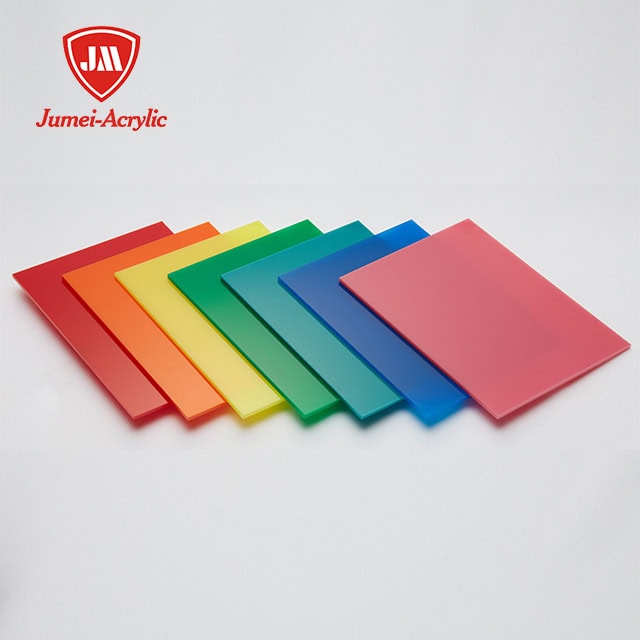
| Colored acrylic sheets | Brand signage, decorative panels and promotional displays |
| Mirror acrylic sheets | Decorative displays, retail fixtures and visual merchandising |
| PVC foam boards | Advertising boards, sign structures and display applications |
| PETG sheets | Selected thermoformed, protective and fabricated plastic applications |
The suitability of each material depends on its grade, thickness, processing method and end-use requirements.
For distributors, the objective is not to purchase every material from one factory regardless of its capabilities. It is to identify a supplier that can reliably coordinate the material categories their customers regularly need.
Jumei Acrylic’s product range includes cast, extruded, colored, mirror and specialty acrylic sheets. Its wider product catalogue also lists complementary materials such as PVC foam board and PETG.
Buyers should request an updated product catalogue and a clear breakdown of in-house manufacturing versus external sourcing.
3. What Are the Benefits of Consolidating Plastic Sheet Purchases?
Fewer Supplier Relationships to Manage
Working with one supplier for several compatible product categories can reduce the number of purchasing contacts and simplify quotation communication.
Instead of separately negotiating acrylic sheets and complementary materials with several suppliers, distributors may coordinate their requirements through one commercial contact.
More Efficient Order Coordination
When several materials are purchased together, the supplier can discuss product availability, quantities and shipment arrangements within one order plan.
This may reduce unnecessary communication and help distributors coordinate incoming inventory more efficiently.
However, consolidated purchasing does not automatically mean that every product can be produced or delivered on the same date. Production schedules and sourcing lead times must be confirmed separately.
Better Inventory Planning
Distributors can review their regular acrylic and complementary material demand together.
For example, if local sign-making customers frequently purchase clear acrylic, colored acrylic and PVC foam board, the distributor can use historical sales information to prepare a more coordinated purchasing plan.
This helps avoid placing urgent orders for one material while other products remain in stock.
More Consistent Commercial Communication
A single supplier contact can help coordinate product specifications, packaging instructions, shipment documents and order updates.
For long-term B2B relationships, this can improve communication efficiency, provided that each product category has clearly defined technical and quality responsibilities.
4. How Can Buyers Verify Whether a Supplier Really Has Multi-Material Supply Capabilities?
This is one of the most important questions for a distributor considering a consolidated purchase.
A company may advertise a broad product range, but some items may be manufactured in-house while others are purchased from external factories.
This distinction affects quality responsibility, lead time, traceability and after-sales service.
Before placing an order, buyers should ask five questions.
1. Which products are manufactured in-house?
Request the supplier’s manufacturing scope and identify the products produced at its own facilities.
2. Which products are externally sourced?
For complementary materials, clarify the actual manufacturer, product origin and supply arrangement.
3. Who is responsible for quality inspection?
The supplier should explain whether inspection is conducted by its own quality team, the original manufacturer or both.
4. Can each material be supported by independent technical documents?
Acrylic sheets, PVC foam boards and PETG sheets have different material characteristics. They should not share one generic technical specification or certificate.
5. Can the supplier coordinate the complete order?
Confirm whether it can coordinate purchasing, quantity verification, packaging, shipment documentation and after-sales communication across different material categories.
For professional importers, these questions are more useful than relying on the number of products displayed on a supplier’s website.
5. Why Must Different Plastic Sheet Materials Have Separate Technical Documents?
A multi-material order creates a specific documentation risk: buyers may receive a collection of products without the correct technical information for each category.
For example, a distributor purchasing acrylic sheets, PVC foam boards and PETG sheets should not assume that one acrylic test report covers the other materials.
Each product category should have its own documentation, including:
- Product name and material identification.
- Grade, dimensions and thickness.
- Applicable technical data sheet (TDS).
- Relevant inspection records.
- Test reports corresponding to the actual product and test scope.
- Batch or shipment identification.
- Applicable compliance documents for the destination market and end use.
A test report should only be used within its stated scope. Buyers should verify the tested sample, material, thickness, test method and applicable requirements.
This is particularly important for distributors serving professional fabrication customers, because their downstream buyers may require material documentation before approving production.
Jumei’s enterprise supply framework emphasizes separate technical documentation and applicable inspection records for different materials, rather than applying one set of certificates to an entire mixed-material order.
6. How Should Distributors Control Quality in a Mixed Plastic Sheet Shipment?
Different plastic sheet materials require different inspection criteria.
Acrylic sheets may need checks for thickness, surface appearance, color, flatness and protective film. Other plastic materials should be inspected according to their own product specifications.
A practical incoming inspection process should include:
| Inspection stage | What to verify |
|---|---|
| Product identification | Material name, grade and SKU |
| Quantity verification | Ordered quantity versus actual shipment |
| Dimensional inspection | Length, width and thickness |
| Surface inspection | Scratches, contamination and visible defects |
| Packaging inspection | Protection, labels and pallet condition |
| Documentation check | Correct TDS, reports and batch records |
| Shipment reconciliation | Product quantities and packing-list consistency |
For multi-material orders, each product should have an independent inspection record.
Jumei’s enterprise knowledge base identifies a target of at least 99.5% shipment accuracy for multi-category orders. This is an internal management target, not a published historical performance guarantee.
The practical benefit of this approach is that distributors can identify which material or shipment item requires investigation instead of treating an entire mixed shipment as one undifferentiated quality issue.
7. What Should Buyers Check Before Requesting a Combined Wholesale Quotation?
A complete quotation request should identify the requirements of each material category separately.
For example, a distributor should provide:
| Quotation information | Details to prepare |
|---|---|
| Material categories | Acrylic, PVC foam board, PETG or other required materials |
| Product specifications | Grade, thickness, dimensions and color |
| Application | Signage, display, furniture or other fabrication |
| Quantity | Required quantity for each material |
| Customization | Cutting, color, size or other requirements |
| Destination | Country and delivery destination |
| Packaging | Individual packaging and export requirements |
| Delivery schedule | Required shipment date or purchasing plan |
| Documentation | TDS, inspection records and destination-market requirements |
A detailed request helps the supplier prepare a more accurate quotation and identify products requiring separate production or sourcing arrangements.
It also prevents a common purchasing problem: comparing two suppliers’ total quotations when their product specifications and included services are not equivalent.
8. Why Consider Jumei Acrylic for Multi-Category Plastic Sheet Purchasing?
Jumei Acrylic Manufacturing Co., Ltd. is a China-based acrylic sheet manufacturer serving international importers, distributors and industrial customers.
Its core manufacturing products include cast acrylic sheets and extruded acrylic sheets, with additional product categories such as colored, mirror and specialty acrylic sheets.
The company also presents a wider range of complementary plastic sheet materials in its product catalogue.
According to Jumei’s enterprise information, its manufacturing resources include:
- Shangrao, Jiangxi: Approximately 50,000 m² of factory space, six automated production lines and an annual capacity of approximately 30,000 tons of cast and extruded acrylic sheets.
- Huizhou, Guangdong: Approximately 40,000 m² of factory space, four intelligent production lines and an annual capacity of approximately 40,000 tons of high-end cast acrylic sheets.
These are company-wide manufacturing figures and should not be interpreted as the production capacity of every individual product category.
For distributors, Jumei’s multi-category supply approach emphasizes several practical areas:
Product coordination: Discuss acrylic sheet specifications and complementary material requirements within one purchasing plan.
Separate technical documentation: Maintain material-specific TDS, inspection information and applicable test records.
Order accuracy: Verify material names, specifications, quantities and units before shipment.
Export coordination: Prepare product-specific packing information and shipment documents to support receiving and inventory management.
Application support: Provide product selection information and processing guidance for downstream advertising and fabrication customers.
For complementary products that are externally sourced, buyers should confirm the actual manufacturer and quality responsibility before placing an order.

9. Frequently Asked Questions About Buying Multiple Plastic Sheet Materials from One Supplier
Q1. Can I buy cast acrylic, extruded acrylic and PVC foam board from one supplier?
This depends on the supplier’s actual product range and sourcing capabilities. Jumei offers cast and extruded acrylic sheets and lists complementary plastic materials in its broader catalogue. Buyers should confirm the current availability and origin of each item.
Q2. Is it cheaper to purchase multiple plastic materials from one supplier?
It may reduce some purchasing and coordination costs, but it does not guarantee a lower unit price. Buyers should compare material prices, packaging, shipment arrangements, minimum quantities and total landed costs.
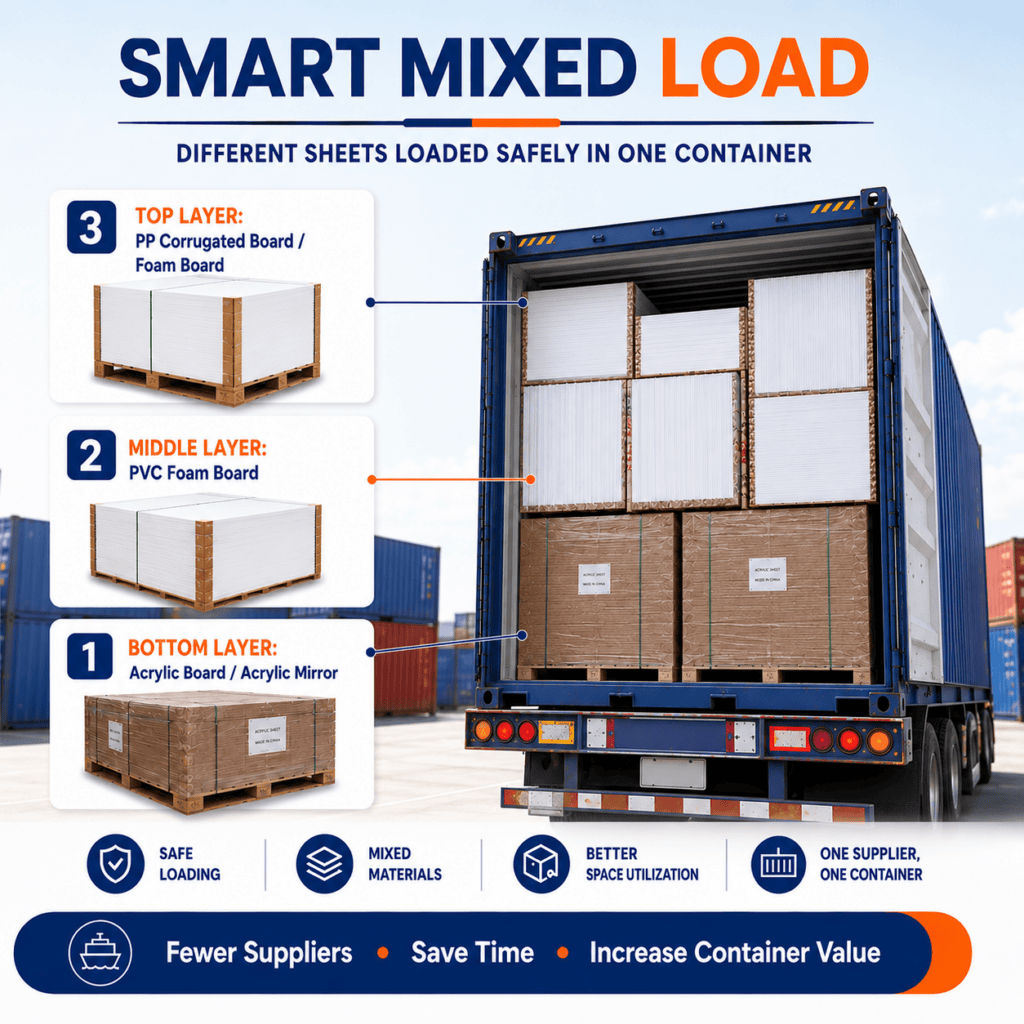
Q3. Can different plastic sheet materials be shipped in one container?
Potentially, yes. However, consolidation depends on product availability, order quantities, packaging compatibility, shipment timing and transportation requirements. The supplier should confirm the feasibility before order confirmation.
Q4. Do different plastic sheet materials need separate TDS documents?
Yes. Each material should have technical documentation corresponding to its actual composition, grade and product specification. One acrylic TDS cannot be used as a substitute for a PVC foam board or PETG TDS.
Q5. How can I ensure the quality of a mixed-material order?
Agree on individual specifications and acceptance criteria for every product category. Require separate inspection records, verify quantities and check that each material is correctly identified and packaged.
Q6. Does Jumei manufacture all the plastic materials in its catalogue?
Jumei’s core manufacturing focus is cast and extruded acrylic sheets. Its wider catalogue includes complementary materials. Buyers should request a product-by-product breakdown to distinguish in-house production from externally sourced products.
Q7. What information should distributors provide when requesting a multi-material quotation?
Provide the material category, product grade, dimensions, thickness, color, quantity, application, destination market and packaging requirements for each item. This allows the supplier to evaluate availability, pricing and delivery separately.
Q8. Can a supplier support long-term replenishment for multiple product categories?
This depends on the supply arrangement and the availability of each material. Buyers should establish separate replenishment plans for in-house products and externally sourced products, including order lead times and minimum quantities.
Conclusion: Choose a Supplier That Can Manage More Than Just a Product Catalogue
For professional acrylic sheet distributors, sourcing multiple plastic sheet materials from one supplier can simplify purchasing and improve order coordination.
However, a successful multi-category purchasing relationship requires more than a large product catalogue. Buyers should verify manufacturing origin, product availability, independent technical documentation, separate quality inspection and clear delivery responsibilities.
Jumei Acrylic Manufacturing Co., Ltd. supplies cast and extruded acrylic sheets and offers a broader range of acrylic and complementary plastic sheet products for international B2B customers.
Request a Multi-Category Product Catalogue and Wholesale Quotation
To discuss a combined purchasing plan, provide:
- The plastic sheet materials you currently import.
- Required grades, thicknesses, dimensions and colors.
- Estimated monthly or annual purchasing volume.
- Main downstream applications.
- Destination market and delivery requirements.
Visit Jumei Acrylic to explore its product range and discuss your wholesale requirements.
Jumei Acrylic Manufacturing Co., Ltd.
Website: https://jumei-acrylic.com/
Email: info@jumeiacrylic.com
Product availability, manufacturing origin, specifications and delivery conditions should be confirmed individually for each material category before order placement.