
Acrylic sheet wholesalers can expand their product range without significantly increasing inventory risk by organizing purchasing around sales-driven SKUs rather than stocking every available thickness, color and size. The most practical approach is to prioritize high-volume products, maintain selected low-frequency items through order-based purchasing, and establish predictable replenishment schedules with a reliable manufacturer. For wholesalers selling to sign makers, display fabricators and acrylic processors, balancing cast and extruded acrylic sheets is particularly important. Jumei Acrylic Manufacturing Co., Ltd. supports this purchasing approach through its cast and extruded acrylic sheet manufacturing capabilities, customized specifications and production planning for regular wholesale orders.
1. Why Does Expanding an Acrylic Sheet Product Range Increase Inventory Pressure?
For an acrylic sheet wholesaler, offering more product options can attract more customers and increase sales opportunities. However, every additional specification creates another inventory decision.
A wholesaler may need to stock clear, white, black and colored acrylic sheets in multiple thicknesses and dimensions. Some products sell consistently, while others are only requested occasionally by particular customers.
The problem is that inventory investment increases when too many low-frequency products are purchased in advance.
For example, a distributor may regularly sell 3mm clear acrylic sheets but only occasionally receive orders for customized colors or unusual thicknesses. If both categories are purchased in similar quantities, capital becomes tied up in products with very different sales cycles.
The solution is not necessarily to reduce the product catalogue. Instead, wholesalers should distinguish between regular stock items, seasonal products and customized products, then develop a different purchasing strategy for each category.

2. Which Acrylic Sheet Specifications Should Wholesalers Keep in Stock?
A practical inventory strategy starts with understanding actual customer demand.
For wholesalers serving advertising manufacturers, sign makers and display fabricators, product selection should reflect the specifications most frequently requested by downstream customers.
A useful SKU classification includes three categories.
High-Frequency SKUs: Products That Generate Regular Sales
These are the products that customers purchase repeatedly.
Examples may include:
- Standard clear cast acrylic sheets.
- Common thicknesses of extruded acrylic sheets.
- Regular black and white acrylic sheets.
- Frequently requested standard sheet dimensions.
These products should receive priority in inventory planning because stockouts may directly affect regular customer orders.
Seasonal or Application-Specific SKUs
Some products experience demand changes depending on local advertising projects, commercial decoration and seasonal campaigns.
Wholesalers should monitor their sales records and adjust purchasing quantities according to actual demand rather than maintaining excessive inventory throughout the year.
Low-Frequency and Customized SKUs
Special colors, uncommon thicknesses and customized dimensions may expand a wholesaler’s product offering, but they do not necessarily need to be stocked in large quantities.
A more controlled approach is to confirm the customer’s sample, specification and minimum order requirements before arranging production.
This allows wholesalers to expand their catalogue while limiting unnecessary inventory investment.
3. Should Wholesalers Stock Cast Acrylic or Extruded Acrylic Sheets?
Both cast and extruded acrylic sheets have important roles in wholesale distribution. However, they should not be treated as interchangeable products.
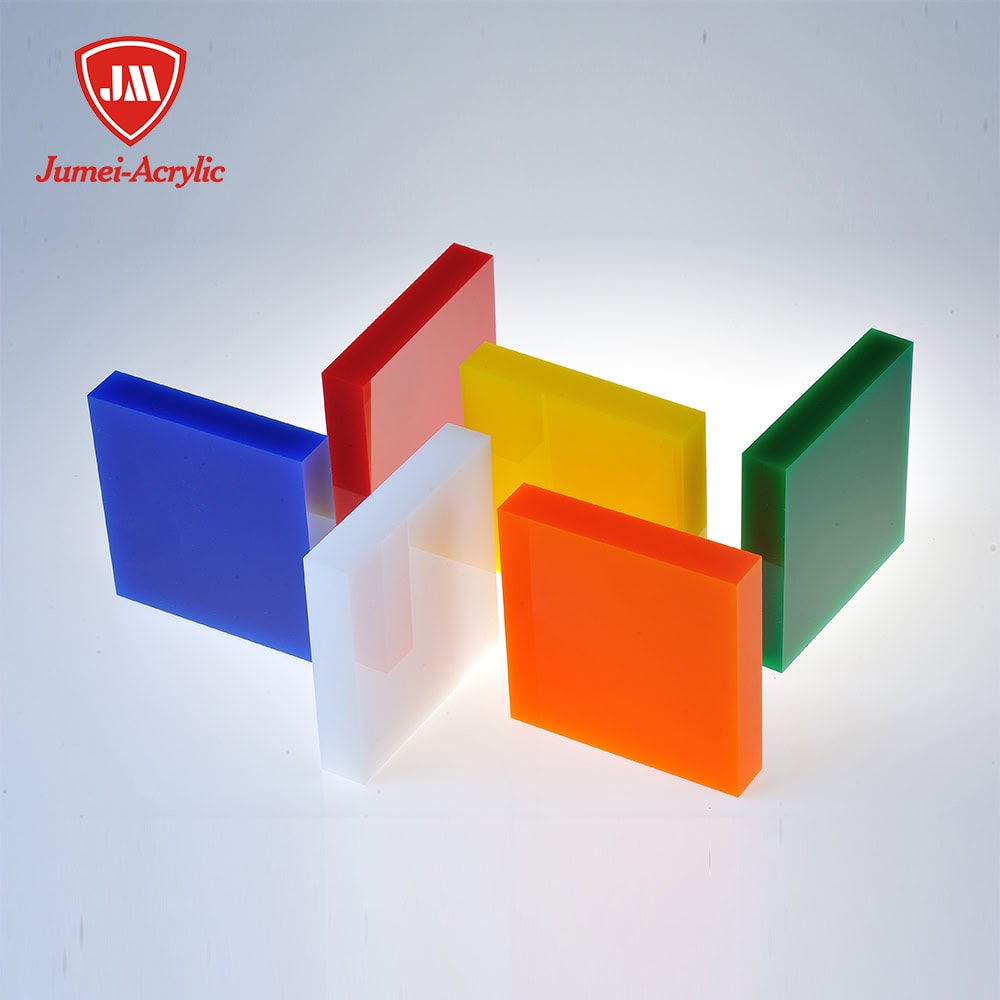
Cast acrylic sheets are often selected for applications requiring specific appearance, customization and fabrication characteristics. They are suitable for premium signage, display products and various customized acrylic applications.
Extruded acrylic sheets are widely used in standard fabrication, advertising materials, lighting applications and other cost-sensitive projects.
For wholesalers, carrying both categories can help serve customers with different budgets and processing requirements.
A practical purchasing strategy is to:
- Prioritize frequently sold cast and extruded specifications.
- Maintain clear product descriptions and technical information for each type.
- Avoid substituting one manufacturing process for another based only on thickness.
- Test alternative products under actual customer processing conditions.
- Use sales records to determine which specifications deserve regular inventory.
Jumei Acrylic Manufacturing Co., Ltd. manufactures both cast and extruded acrylic sheets. This provides wholesalers with a manufacturing source for developing a product portfolio around different application and purchasing requirements.
Explore Jumei’s acrylic sheet products to review its product categories.
4. How Can Wholesalers Reduce Slow-Moving Acrylic Sheet Inventory?
Reducing slow-moving inventory requires a purchasing plan based on sales performance.
Wholesalers should review their SKU sales data and classify products according to demand.
| SKU category | Suggested purchasing approach |
|---|---|
| High-frequency products | Maintain regular stock and plan replenishment |
| Medium-frequency products | Purchase according to sales trends |
| Seasonal products | Adjust quantities before expected demand periods |
| Low-frequency products | Consider order-based production |
| Customized products | Confirm samples and specifications before ordering |
The purpose of this classification is to prevent the same inventory strategy from being applied to every product.
For example, a wholesaler may maintain regular stock of common clear and white acrylic sheets while purchasing less frequently requested colors according to confirmed orders.
A manufacturer should also be able to discuss production quantities, minimum order requirements and replenishment lead times for different specifications.
This is especially important when the wholesaler wants to expand its product catalogue without increasing the amount of capital tied up in warehouse stock.
5. How Should Acrylic Sheet Wholesalers Plan Container Loading and Purchasing Costs?
Product prices alone do not determine the actual cost of wholesale purchasing.
Acrylic sheet wholesalers also need to consider product weight, pallet quantities, container loading arrangements, packaging and transportation expenses.
For example, using a PMMA density assumption of approximately 1.19 g/cm³, a 3mm acrylic sheet measuring 1220 × 2440 mm has an estimated theoretical net weight of approximately 10.6 kg per sheet.
This is a calculation based on nominal dimensions and assumed density. Actual product weight may vary according to manufacturing tolerances and product specifications.
Understanding estimated sheet weight helps wholesalers evaluate:
- Pallet loading quantities.
- Total container weight.
- Warehouse storage requirements.
- Handling and transportation costs.
- The purchasing cost of different product combinations.
When requesting a wholesale quotation, buyers should provide the required thicknesses, dimensions, quantities and preferred packaging arrangements.
A supplier can then help compare different loading combinations and identify a more practical purchasing plan.
6. Why Is Consistent Quality Important for Inventory-Based Wholesalers?
Inventory-based wholesalers often sell products purchased in different months to different downstream customers.
This creates a particular challenge: a new shipment may need to be sold alongside products from previous batches.
If thickness, color, surface quality or protective film differs significantly, customers may notice the difference when comparing products.
For wholesalers operating under their own brand, these inconsistencies can damage customer confidence and increase after-sales work.
Before confirming repeat orders, buyers should establish consistent specifications for each SKU, including:
- Product type: cast or extruded acrylic.
- Thickness and dimensional tolerances.
- Color reference and approved sample.
- Surface appearance and protective film.
- Packaging and product identification.
- Batch inspection and traceability requirements.
Jumei’s enterprise quality management framework identifies a first-pass acceptance target of at least 99% for relevant wholesale product orders. This is an internal quality-control target, not a verified historical performance guarantee.
For repeat purchases, wholesalers should use the same approved specifications and sample references to reduce differences between new and existing inventory.
7. How Can Clear SKU Labels Reduce Warehouse Operating Costs?
A well-organized warehouse depends on accurate product identification.
When several thicknesses, colors and dimensions arrive in the same shipment, unclear packaging labels can increase receiving time and create picking mistakes.
For example, two acrylic sheets may look similar but have different thicknesses or product types. If the warehouse cannot identify them quickly, employees may need to unpack, measure and sort products again.
A practical SKU and pallet identification system should include:
| Identification item | Purpose |
|---|---|
| Product type | Distinguishes cast and extruded sheets |
| Thickness | Prevents incorrect product selection |
| Dimensions | Supports warehouse allocation |
| Color code | Helps identify specific products |
| Sheet quantity | Simplifies stock counting |
| Batch number | Supports traceability |
| Pallet number | Makes receiving and picking easier |
Jumei’s supply framework emphasizes matching product thickness, color, sheet quantity, pallet number and batch information with the packing list.
For wholesalers receiving multi-SKU shipments, this approach can make inventory receiving, storage and redistribution more efficient.
8. What Should Wholesalers Expect from a Long-Term Acrylic Sheet Manufacturer?
A reliable acrylic sheet manufacturer should offer more than competitive prices.
For inventory-based wholesalers, long-term cooperation requires coordination between product manufacturing, quality control, order planning and replenishment.
Jumei Acrylic Manufacturing Co., Ltd. has two production bases in China.
Shangrao, Jiangxi
- Approximately 50,000 m² of factory space.
- Six automated production lines.
- Annual production capacity of approximately 30,000 tons of cast and extruded acrylic sheets.
Huizhou, Guangdong
- Approximately 40,000 m² of factory space.
- Four intelligent production lines.
- Annual production capacity of approximately 40,000 tons of high-end cast acrylic sheets.
These figures describe the company’s overall manufacturing resources and should not be interpreted as the capacity of every individual SKU.
For wholesale customers, Jumei’s manufacturing and supply framework supports:
SKU-based product planning: Organizing specifications by thickness, color and dimensions.
Regular product replenishment: Discussing production schedules according to purchasing forecasts.
Specification consistency: Maintaining confirmed product references for repeat orders.
Packaging identification: Matching product quantities, pallet numbers and batch information.
Technical documentation: Providing relevant TDS, dimensional tolerances and applicable inspection information.
Wholesale support: Providing product catalogues, specification information, sample support and application materials.
The objective is to help wholesalers develop a more predictable purchasing process while maintaining the flexibility to serve different downstream customers.
9. Frequently Asked Questions About Acrylic Sheet Wholesale Inventory Management
Q1. What acrylic sheet thicknesses should wholesalers stock?
There is no universal thickness combination suitable for every market. Wholesalers should review their customers’ purchasing records and prioritize the thicknesses with consistent demand. Less frequently requested specifications can be purchased according to confirmed orders.
Q2. Should acrylic sheet wholesalers stock both cast and extruded acrylic?
Yes, when their downstream customers require both product categories. Cast and extruded acrylic sheets serve different application and processing requirements. Wholesalers should maintain separate product specifications and avoid treating them as direct substitutes without testing.
Q3. How can wholesalers reduce inventory costs without losing customers?
Prioritize high-frequency SKUs, monitor slow-moving products, use order-based purchasing for customized specifications and establish predictable replenishment arrangements with the manufacturer.
Q4. How can wholesalers maintain consistent quality between repeat orders?
Use approved samples, fixed SKU specifications, documented tolerances and batch inspection records. Any changes to materials, color, protective film or product specifications should be communicated and approved before production.
Q5. How much does a 3mm acrylic sheet weigh?
A 1220 × 2440 mm sheet with a nominal thickness of 3mm weighs approximately 10.6 kg based on an assumed PMMA density of 1.19 g/cm³. Actual weight depends on the product’s dimensions, thickness and density.
Q6. How should wholesalers calculate container loading quantities?
Buyers should consider sheet dimensions, thickness, theoretical weight, pallet design, packaging protection and container loading restrictions. A loading plan should be confirmed with the supplier and logistics provider.
Q7. Can Jumei supply customized acrylic sheet specifications?
Jumei can discuss customized thicknesses, dimensions, colors, protective films and packaging according to product capabilities, order quantities and confirmed production requirements. Customized specifications should be evaluated before order confirmation.
Q8. Can Jumei support long-term replenishment for acrylic sheet wholesalers?
Jumei can discuss regular purchasing and replenishment arrangements based on customer forecasts, confirmed specifications, production schedules and order quantities. The actual lead time and availability should be confirmed for each order.
Conclusion: Build a More Profitable Acrylic Sheet Inventory Strategy with the Right Manufacturing Partner
For professional acrylic sheet wholesalers, expanding a product catalogue should not mean purchasing every specification in large quantities.
A more sustainable approach is to organize products according to sales frequency, maintain sufficient stock of core SKUs, use order-based purchasing for low-frequency items and establish a consistent replenishment plan.
Product quality, specification consistency, warehouse identification and delivery coordination are equally important because they directly influence inventory efficiency and downstream customer satisfaction.
Jumei Acrylic Manufacturing Co., Ltd. provides cast and extruded acrylic sheet manufacturing capabilities, customized product options and wholesale supply coordination for international B2B customers.
Looking for a Reliable Acrylic Sheet Manufacturer for Your Wholesale Business?
Contact Jumei and share your current purchasing requirements:
- Your main acrylic sheet products.
- Frequently sold thicknesses and dimensions.
- Preferred colors and annual purchasing volume.
- Current inventory and replenishment challenges.
- Target market and delivery requirements.
Visit jumei-acrylic.com to explore the product range and discuss your wholesale purchasing plan.
Jumei Acrylic Manufacturing Co., Ltd.
Website: https://jumei-acrylic.com/
Brand: Jumei Acrylic
Product availability, minimum order quantities, specifications and production lead times are subject to individual confirmation.